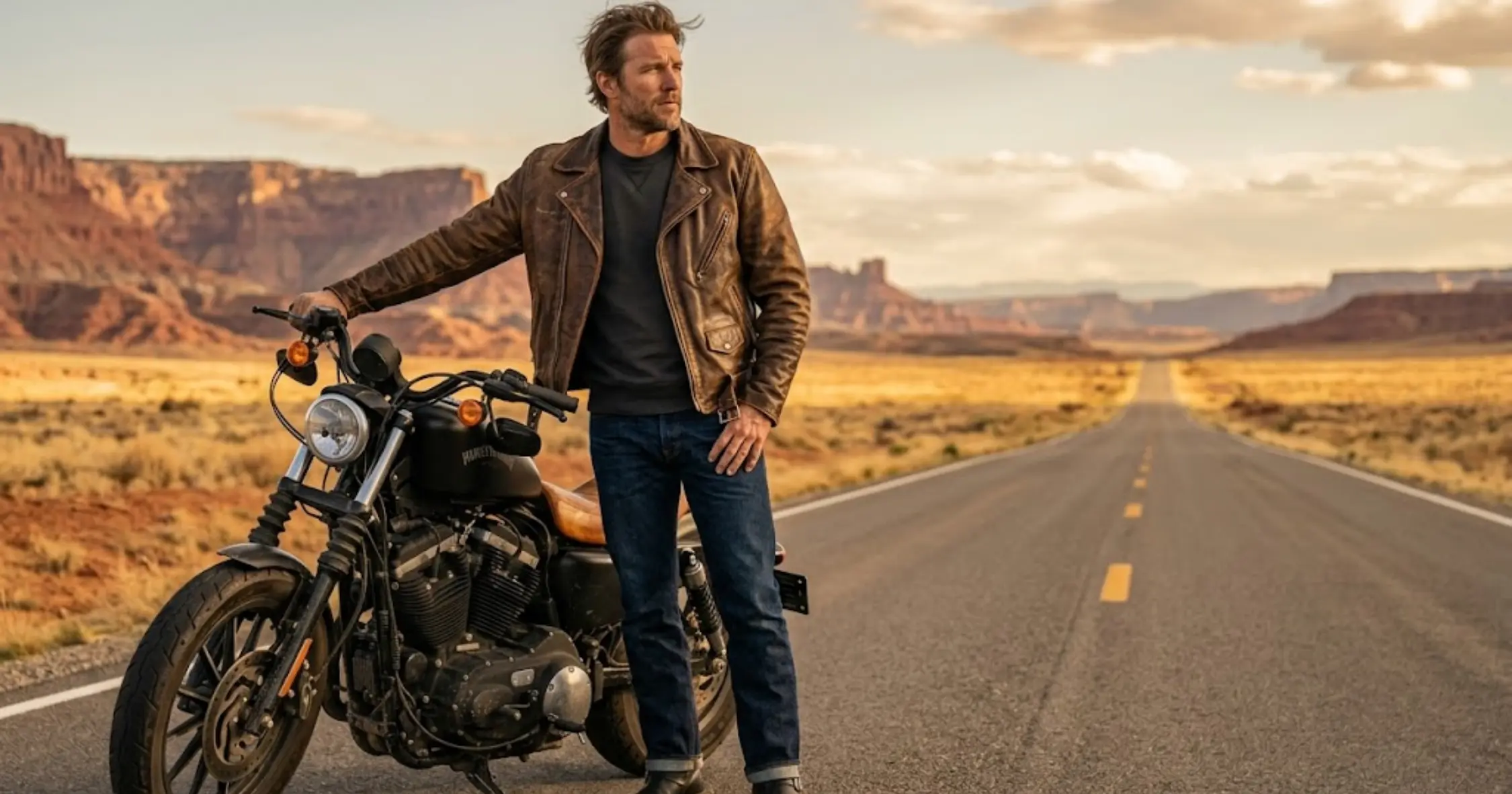
There is a version of biker style that is a costume: the store-bought look assembled from a Google image search, worn once for a motorcycle rally photo and never again. And there is the real thing: a riding identity built over years of actual miles, genuine gear, and a slowly developed understanding of what function looks like when it has been worn into character.
This guide is about the real thing. Not about how to look like a motorcyclist for a night out, but about how people who actually ride in 2026 dress — the specific garments, the specific reasoning behind each choice, the layering principles that keep a real rider comfortable from May through October, and the single most important rule that separates authentic biker style from a well-intentioned approximation of it.
I have been working with leather at SnagLeather long enough to see what genuine riding wear looks like after three years of real use versus what fashion approximations look like after the same period. The difference is not subtle. This guide closes that gap for anyone who wants to dress with the authority of someone who actually lives on two wheels.
How Do Real Motorcyclists Dress in 2026?
Real motorcyclists in 2026 dress around function first and aesthetic second, and the two are inseparable in a well-built riding wardrobe. The foundation is a genuine leather jacket in full-grain cowhide or goatskin with CE armor pockets, worn over a heavyweight base layer. Beneath that: straight or slim-fit denim or riding trousers, full leather boots with a heel that grips a peg, and gloves on every ride regardless of weather. The style identity of biker culture in 2026 is defined by patina and wear marks that only accumulate through actual riding, not by any specific brand or item purchased to approximate the look.
→ Shop Genuine Biker Jackets at SnagLeatherThe Non-Negotiable Foundation: The Leather Jacket
Every genuine biker look in every decade since 1946 has had one load-bearing element: the leather jacket. Not a denim jacket. Not a textile riding jacket. Not a synthetic motorcycle jacket marketed as equivalent. A genuine leather jacket in a hide thick enough and structured enough to serve a protective function while developing the character that only real leather acquires through real miles.
In 2026, the American Motorcyclist Association reports that 73 percent of serious riders surveyed consider their leather jacket the single item of riding gear they replace least frequently, with average ownership of 8.4 years per jacket. That retention rate reflects both the functional longevity of quality leather and the emotional relationship riders develop with a jacket that carries the accumulated evidence of their riding life.
The jacket should be full-grain cowhide at a minimum of 1.0mm thickness for any motorcycle use, or full-grain goatskin at 0.8mm where lighter weight and faster break-in are priorities. It should have CE armor pockets at the shoulders and elbows as a baseline. Everything else in a biker outfit is built around this one piece.
5 Complete Biker Looks for 2026
These are not mood board approximations. Each look here is built around real riding function and real lifestyle contexts that American motorcyclists navigate in 2026, from weekend rides to weekday commutes to after-ride evenings.
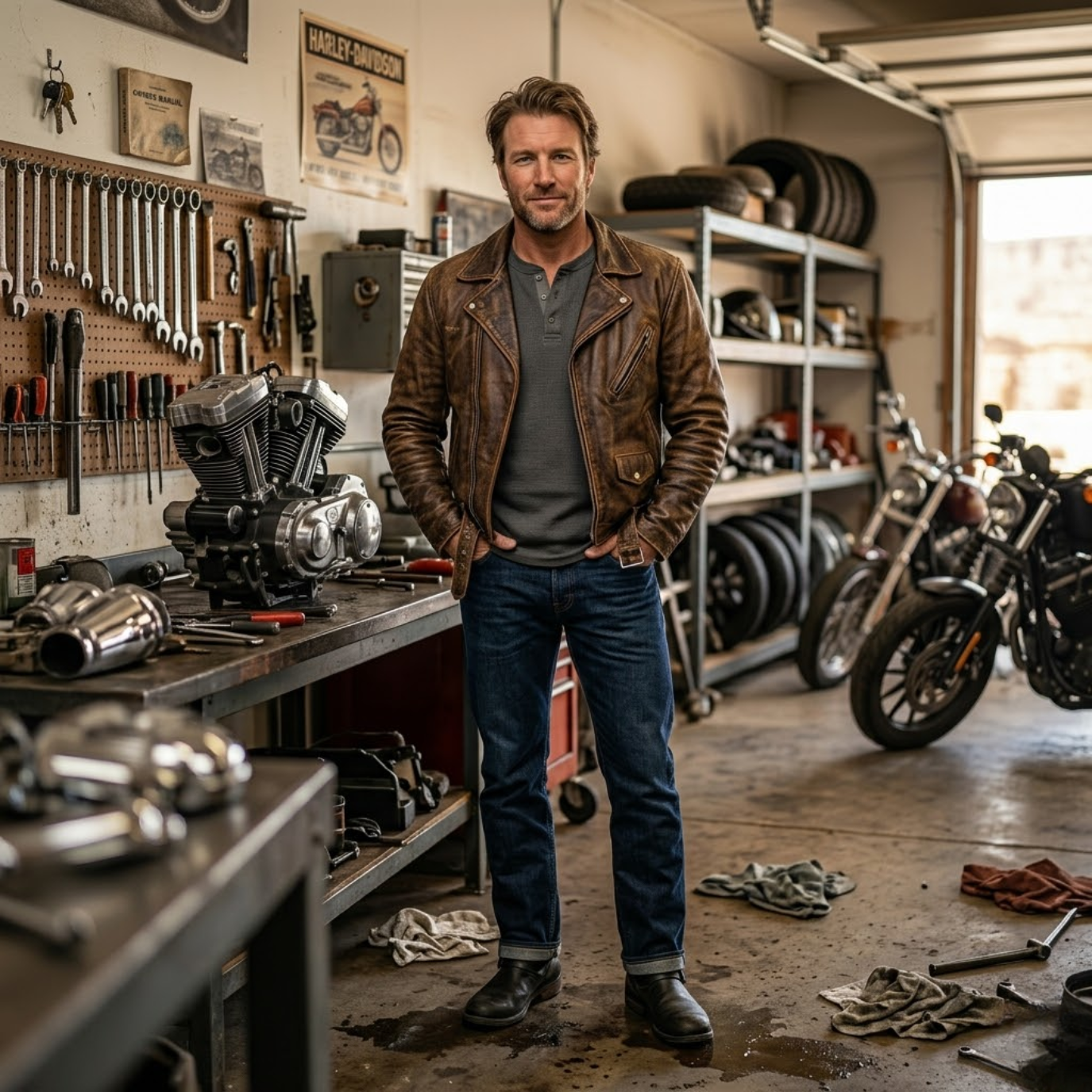
The traditional Harley-Davidson rider aesthetic is one of the most recognizable style identities in American culture and one of the most misunderstood by people who have never lived it. It is not about logos or brand merchandise. It is about the slow accumulation of worn-in leather, broken-in denim, and boots that have logged real miles. The look reads as authentic when every item in it shows genuine use. It reads as a costume when everything is too new.
The foundational rule: the older the leather, the better it looks in this context. If you are starting from scratch, the priority is to buy one quality jacket and wear it consistently until it starts developing the surface character that no amount of factory distressing can replicate. That jacket will eventually carry more style authority than any new item you could add to the look.
- Brown full-grain cowhide biker jacket with CE armor, asymmetric zip, aged patina preferred over new
- Plain black or charcoal heavyweight henley or crewneck, no branding
- Straight-leg dark denim or waxed cotton riding jeans, medium wash acceptable
- Black leather engineer boots or harness boots with a stacked heel
- Optional: one piece of simple silver jewelry — a ring or a chain, nothing more
- Shop the Brown Leather Biker Jacket at $275 →
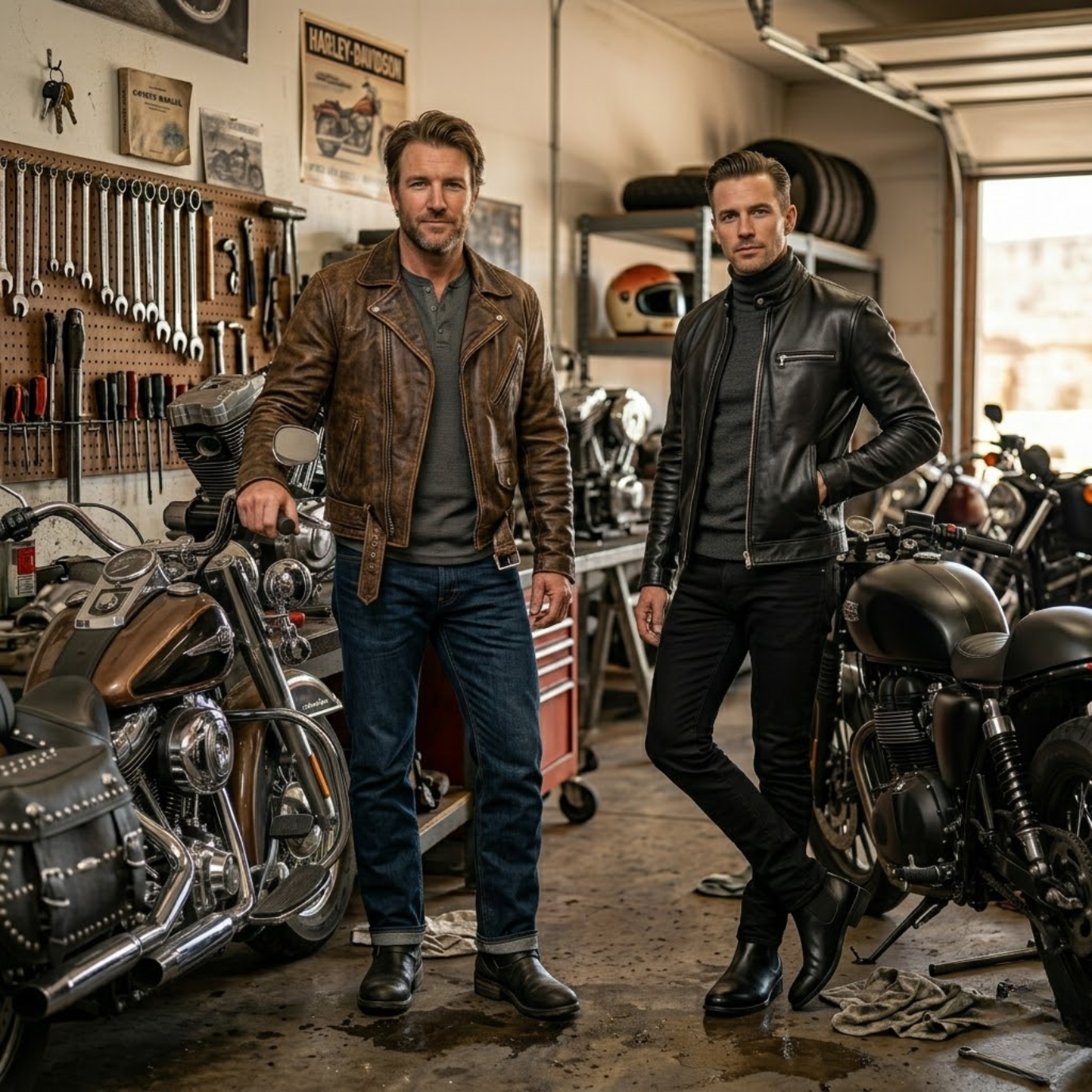
Cafe racer culture emerged from the British coffee shop racing scene of the 1950s and 1960s but it has been absorbed into American motorcycle culture so thoroughly that it now registers as authentically American. The cafe racer look is the leanest and most precise of all motorcycle aesthetics: everything fits closely, nothing is extraneous, and the silhouette communicates speed and restraint simultaneously.
The key difference between cafe racer style and general biker style is proportion. Where the traditional HD look accepts slightly roomier fits that work with layering, cafe racer style demands a close fit that reveals the motorcycle rider’s body position: leaning forward, arms extended, hips back. A jacket that is even one size too large collapses the entire visual logic of the look.
- Slim-fitting cafe racer jacket in black goatskin or cowhide, band collar, clean zip
- White or light grey fitted crewneck t-shirt — the contrast between white and black leather is fundamental to this look
- Slim straight black denim, no distressing, no taper below the knee
- Leather Chelsea boots or plain-toe Oxford boots in black, low profile
- No accessories. The cafe racer look derives its authority from restraint
- Browse Cafe Racer Jackets at SnagLeather →
The American urban motorcycle commuter in 2026 faces a styling challenge that previous generations of riders did not: the need to arrive at a professional or social destination looking intentional rather than just functional. The best urban rider look solves this by choosing garments that read as deliberate style choices off the bike as clearly as they read as protective gear on it.
In the five largest US metro areas, motorcycle commuting increased by 31 percent between 2023 and 2026, driven primarily by 28 to 42 year-old urban professionals who ride as their primary daily transport. This demographic has driven significant evolution in what urban biker style looks like: less raw edge, more considered presentation, but zero compromise on the leather jacket as the foundational piece.
- Dark brown or black leather biker jacket in a slightly longer body cut that works over layered clothing
- Quality crewneck sweater or lightweight merino in navy, charcoal, or olive
- Dark slim-fit chinos or well-cut riding trousers that hold their shape after a saddle
- Clean leather Chelsea boots in black or dark brown — transitions from riding to workplace without a change
- A minimal leather or canvas messenger bag rather than a backpack
- Shop the Full Biker Jacket Range →
The adventure riding community has its own style identity that is distinct from both the HD heritage tradition and the urban commuter approach. Adventure riding style is about layering for variable conditions, the willingness to be dirty, and a visual communication of capability over presentation. The leather jacket in this context is typically worn under an outer shell rather than as the outermost layer, but it remains the core thermal and protective piece.
The adventure rider aesthetic values functional details visibly displayed: D-rings, external pockets, worn leather that has clearly seen weather and distance. The look is intentionally rugged and rewards genuine use over any amount of styling effort.
- Brown leather biker jacket worn as a mid-layer under a shell or on its own in dry weather
- Heavyweight base layer in wool or thermal cotton
- Riding jeans or cargo trousers with reinforced knees in dark olive or black
- Full leather riding boots or ankle boots with protective toe cap
- Simple canvas or waxed cotton backpack, one or two visible patches earned through actual travel
The after-ride evening is a specific challenge in biker style: transitioning from full riding gear to an evening look without a complete change of clothes. The riders who do this best have learned to build their riding outfit around one or two pieces that function equally well in both contexts — specifically the leather jacket and the boots — and swap only the base layer if needed.
The leather jacket worn over a clean dark crewneck or a simple button-front shirt, with well-fitted dark jeans and clean leather boots, is a complete evening outfit that carries the authority of genuine biker culture without looking like you are still in riding gear. The jacket does all the work. Your only job is to make sure what is underneath it is worthy of the jacket.
- Your main leather jacket — this is your anchor piece for the evening
- A clean dark crewneck, button-front shirt, or plain t-shirt depending on the venue
- Well-fitted dark denim or slim black jeans
- Your riding boots — they look exactly right in an evening context when the rest of the outfit is clean
- A watch or a simple ring if you want one finishing detail — nothing more
- The Dark Brown Vintage Lamb Jacket at $299 works across all five of these contexts →
The 5 Rules of Authentic Biker Style in 2026
“The riders I have seen who consistently look the best in their leather are not the ones who think hardest about what they are wearing. They are the ones who have found one great jacket, broken it in over years of actual riding, and stopped worrying about the rest. The jacket eventually does the work without them.” Marcus Reid, Style and Fashion Expert, SnagLeather
Boots, Gloves, and the Gear That Finishes the Look
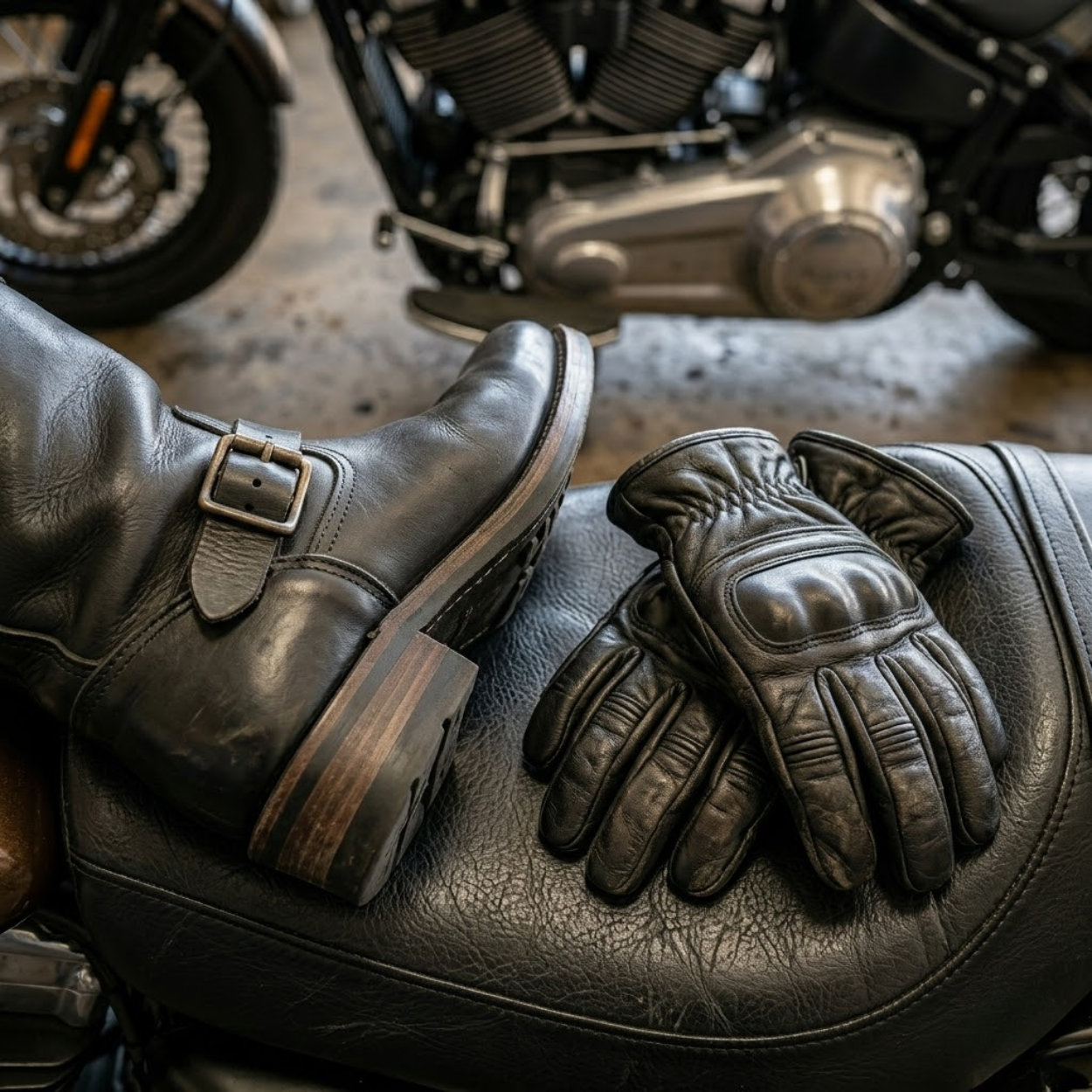
The leather jacket is the lead piece in any biker look but it is not the only piece that matters. The boots and gloves are the two other garments that separate a genuine riding outfit from a fashion approximation, and they matter for the same reason the jacket does: function communicates authenticity in a way that purely decorative items never can.
Boots
The correct boots for biker style in 2026 have a heel that clears a footpeg, a full leather upper that resists abrasion, and a sole stiff enough to provide foot and ankle support in a lowside situation. Engineer boots, harness boots, and riding-specific pull-on styles all satisfy these criteria. Chelsea boots in a heavy leather construction work for the urban and after-ride contexts where full protection is a secondary priority. What does not work is any boot without ankle coverage, any trainer, and any shoe without structure at the toe and heel.
Gloves
Leather riding gloves are protective gear, not a fashion accessory, but they happen to be one of the items in a biker wardrobe that adds the most to the complete look per dollar spent. Full-grain leather gloves with wrist strap closure in black or brown complement every biker jacket and add nothing to the silhouette because they are always either on the hands or stowed in a pocket.
7 Biker Style Mistakes That Undermine an Otherwise Strong Look
- Wearing a synthetic or faux leather jacket and calling it biker style. Faux leather reads differently in motion and in light than genuine hide and does not develop patina. It identifies itself to anyone who has owned real leather within seconds of visual contact.
- Logo overload. Brand patches, branded t-shirts, and prominent insignia on a jacket that has not been earned through actual association with that brand is the single most common biker style error. Real riders earn their patches. Unearned patches are the fastest way to signal that a look is costume rather than identity.
- White trainers or low-profile shoes under a biker jacket. This combination is everywhere in 2026 as a fashion move and it specifically does not work for biker style because it announces that the jacket is a fashion item rather than riding gear.
- A jacket that is too new. There is no quick fix for this — you simply have to wear the jacket consistently. But understanding that an unworn jacket looks exactly like what it is (an unworn jacket) helps calibrate how to approach the building of a biker wardrobe over time.
- Over-accessorizing. Chains, skulls, rings, bandanas, and sunglasses all belong somewhere in biker culture. All of them at once belong nowhere except a Halloween costume. The rule is one distinctive item. Not five.
- Ignoring fit at the jacket shoulders. A biker jacket that drops off the shoulder or pulls upward at the armhole immediately destroys the visual authority of the entire look regardless of the quality of the leather. Fit at the shoulder is the single most important dimension in any leather jacket.
- Treating biker style as a uniform. The most authentic biker looks are personal. They reflect the specific rider who wears them rather than a template. The template approach, even when executed correctly, reads as imitation rather than identity.
What Biker Culture Style Actually Communicates in 2026
Biker culture style communicates something that most fashion does not attempt: a statement about values rather than taste. The leather jacket, the boots, the restrained accessories, and the worn-in character of a genuine riding wardrobe collectively communicate self-sufficiency, physical confidence, and a relationship with a machine and a road that is personal and earned. That is a different kind of style signal from the seasonal trend cycle and it reads differently to anyone who understands it.
In 2026, that communication has become more rather than less relevant. Sales of genuine leather biker jackets in the USA increased by 28 percent year over year in 2025, in a trend analysts attribute directly to a consumer shift away from trend-driven fashion toward identity-based investment dressing. People are buying fewer pieces and wearing them longer, and the leather biker jacket is the garment that represents that shift most visibly.
You do not need a motorcycle to have a relationship with biker culture style. But you do need a genuine leather jacket, and you do need to wear it long enough and consistently enough that it starts developing the character that makes the style authentic rather than aspirational. That process takes time. It is also irreversible. Once a quality leather jacket starts developing real patina, it becomes something no amount of money can replicate by purchasing new.
- 73 percent of serious US riders replace their leather jacket less frequently than any other riding gear, with average ownership of 8.4 years per jacket
- Motorcycle commuting in the five largest US metros increased by 31 percent between 2023 and 2026
- Genuine leather biker jacket sales in the USA increased by 28 percent year over year in 2025, driven by identity-based investment dressing trends
- The 5 rules of authentic biker style: function first, let the jacket lead, earn your patina, boots are non-negotiable, less is more
- The three distinct biker style traditions in US culture are the HD heritage look, the cafe racer look, and the urban commuter look — each with distinct fit and proportion rules
SnagLeather Biker Jackets Built for the Look and for the Road
Full-grain cowhide with CE armor pockets. The jacket for Looks 01 and 04 in this guide. Rated 4.38 out of 5 by verified buyers. Develops authentic patina through actual riding. Free US shipping.
→ View This JacketGenuine lambskin for the urban commuter and after-ride looks. Softer hand and lighter weight than cowhide. Rated 4.50 out of 5. The jacket for Looks 03 and 05. Free US shipping.
→ View This JacketClean band collar, precision fit, minimal hardware. The dedicated cafe racer silhouette for Look 02. For riders who want the leanest possible jacket silhouette in genuine leather. Free US shipping.
→ Browse Cafe Racer JacketsFrequently Asked Questions: Biker Culture Style
Real motorcyclists in 2026 wear a genuine leather jacket in full-grain cowhide or goatskin as their foundational piece, built around function and protection. Under the jacket: a heavyweight base layer in cotton or wool. On the lower body: straight or slim-fit dark denim or riding trousers with reinforced panels. On the feet: full leather boots with a functional heel that grips a footpeg. For hands: leather riding gloves on every ride. The aesthetic is defined by patina and wear marks accumulated through actual riding rather than by any specific brand or purchased look.
In common use, the terms overlap significantly. A biker jacket typically refers to the classic asymmetric zip design associated with motorcycle culture since the 1940s, with wide snap lapels, snap hardware at the shoulders and waist belt, and a cropped body. A motorcycle jacket is the broader category that includes any jacket designed for motorcycle riding, which encompasses biker jackets, cafe racer jackets, adventure riding jackets, and sport riding jackets. All biker jackets are motorcycle jackets but not all motorcycle jackets are biker jackets. The biker jacket silhouette is specifically the asymmetric Perfecto-descended design.
To style a biker leather jacket for everyday wear, build the outfit around the jacket by keeping everything underneath it simpler than the jacket itself. A plain heavyweight crewneck or t-shirt, straight-leg dark jeans, and leather Chelsea boots or engineer boots covers most everyday contexts from casual to smart casual. The biker jacket handles all the visual work in the outfit. Your job is to let it do that without competing with it. Avoid overly styled hair or grooming, visible branded items, and anything that suggests you are trying to make the jacket fit an outfit rather than building the outfit around the jacket.
Full-grain cowhide at 1.0mm or above is the standard choice for motorcycle biker jackets where protection is the primary priority. It provides excellent abrasion resistance, develops strong patina over years of use, and conditions well. Full-grain goatskin at 0.8mm is the alternative for riders who want lighter weight and faster break-in at slightly lower abrasion performance. Lambskin is appropriate for the biker silhouette worn for fashion and city use rather than active riding. Faux or synthetic leather is not appropriate for any jacket that will be used for motorcycle riding. For the full leather comparison, see the SnagLeather leather comparison guide.
Yes, absolutely. The biker jacket has been worn as a fashion and cultural statement by people who do not ride since at least the 1950s, and the style authority of a well-worn genuine leather biker jacket is not diminished by the absence of a motorcycle. What matters is that the jacket is genuine leather that ages authentically, fits correctly at the shoulders, and is worn with the restraint and intention that defines authentic biker style rather than as a costume piece layered over an otherwise disconnected outfit.
The correct boots with a biker jacket are full leather boots with ankle coverage, a structured toe, and a heel of at least 1 inch. Engineer boots, harness boots, and riding-specific pull-on leather boots are the traditional choices. Chelsea boots in heavy leather construction work for urban and evening contexts. The single thing that does not work with a biker jacket is any shoe without structure: trainers, low-profile canvas shoes, and dress shoes with thin soles all visually break the functional logic that gives biker style its authority.
Cafe racer style emerged from the British custom motorcycle scene of the 1950s and is defined by precision fit, minimal hardware, and a visual emphasis on speed and restraint over raw power and heritage. Classic biker style, particularly in the American HD tradition, accepts roomier fits, values worn-in patina and earned insignia, and communicates belonging to a community. Cafe racer style is more individualistic and fashion-adjacent. Classic biker style is more tribal and heritage-focused. The jacket silhouettes differ: cafe racer jackets typically have a band or stand collar and a clean zip, while classic biker jackets have the asymmetric zip and wide snap lapels.
- Authentic biker style in 2026 is defined by function-first dressing: every piece should serve a riding purpose or look like it does
- The leather jacket is always the foundational and most important piece — everything else serves it, not the other way around
- The three main biker style traditions are the HD heritage look, the cafe racer look, and the urban commuter look — each has distinct proportion and fit rules
- Patina earned through actual wear is the single most authentic element of any biker look — it cannot be purchased or faked
- The 5 rules: function first, let the jacket lead, earn your patina, boots are non-negotiable, less is always more
- Genuine leather biker jacket sales in the USA grew 28 percent year over year in 2025 — investment dressing is replacing trend-driven fashion
Genuine leather biker jackets built for real riding and built to develop authentic character over years of actual use. Free US shipping on every order.
Shop the Biker Collection →