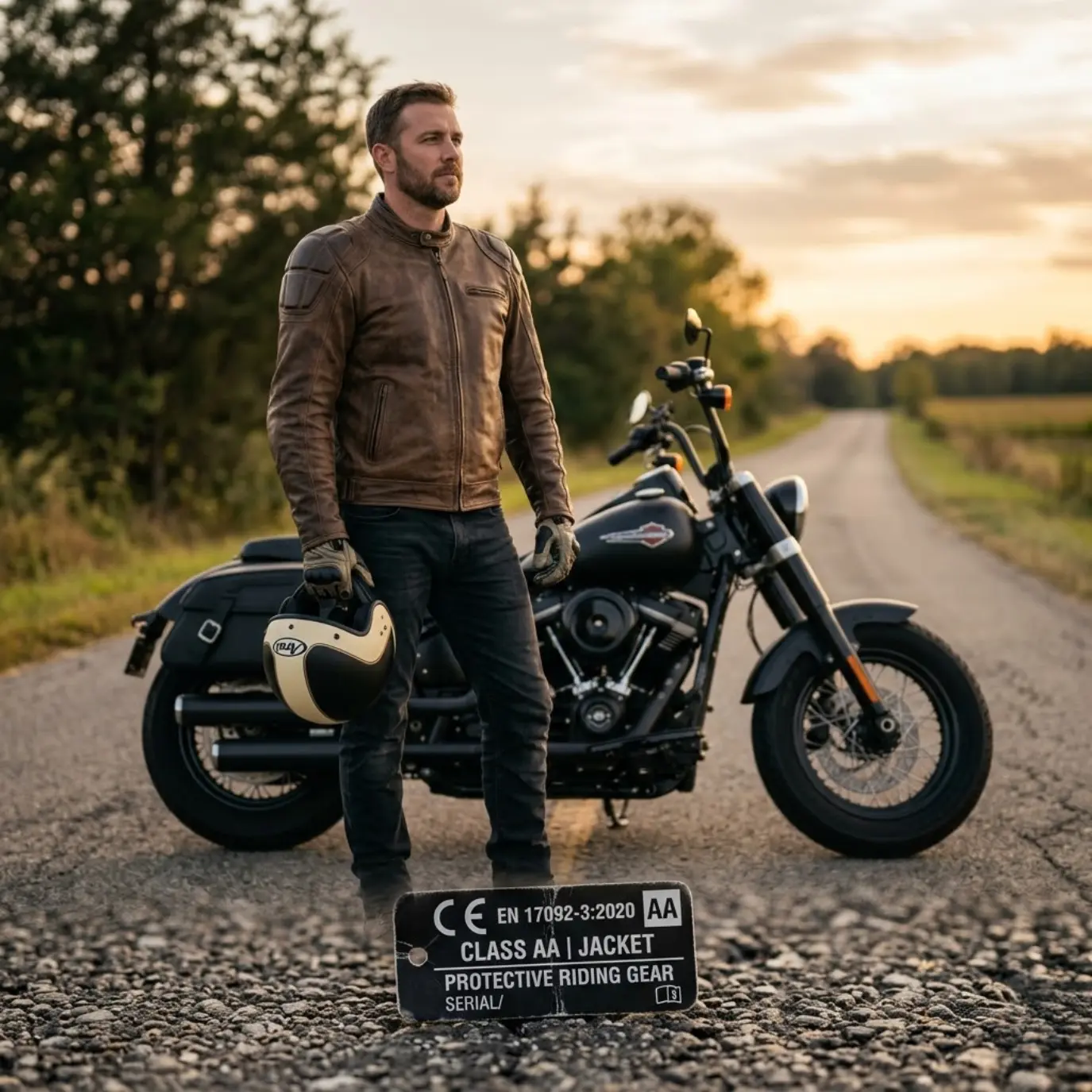
Most riders shopping for a leather motorcycle jacket focus on the right things: leather grade, fit, style. What far fewer riders examine before buying is the one specification that matters most when something actually goes wrong on the road: the CE safety rating. A leather jacket without CE-rated armor is a leather jacket, not a motorcycle jacket. The difference between those two things is measurable in millijoules of impact energy absorbed and in meters per second of abrasion resistance. Both of those numbers have consequences that last well beyond any crash.
This guide gives you the complete picture on CE motorcycle leather jacket safety ratings: what the CE EN 13595 standard actually measures, what the AA, A, and B rating levels mean in practical terms, what armor to look for and where, and what the real risk is of riding in a non-rated jacket versus a CE-compliant one. Every specification in this guide is drawn from the published European standard rather than marketing copy.
What CE Rating Do You Need for a Motorcycle Jacket?
For most road riding in the USA, a leather motorcycle jacket rated CE Level 1 under EN 13595 or EN 17092 is the minimum appropriate standard. Level 2 is recommended for sport and track riding. The jacket needs CE-certified armor at both shoulders and both elbows as a baseline, with back armor strongly recommended. Any jacket without a declared CE rating provides no verified protection in a fall.
→ Shop CE-Ready Motorcycle Jackets at SnagLeatherThe CE EN 13595 Standard: What It Actually Tests
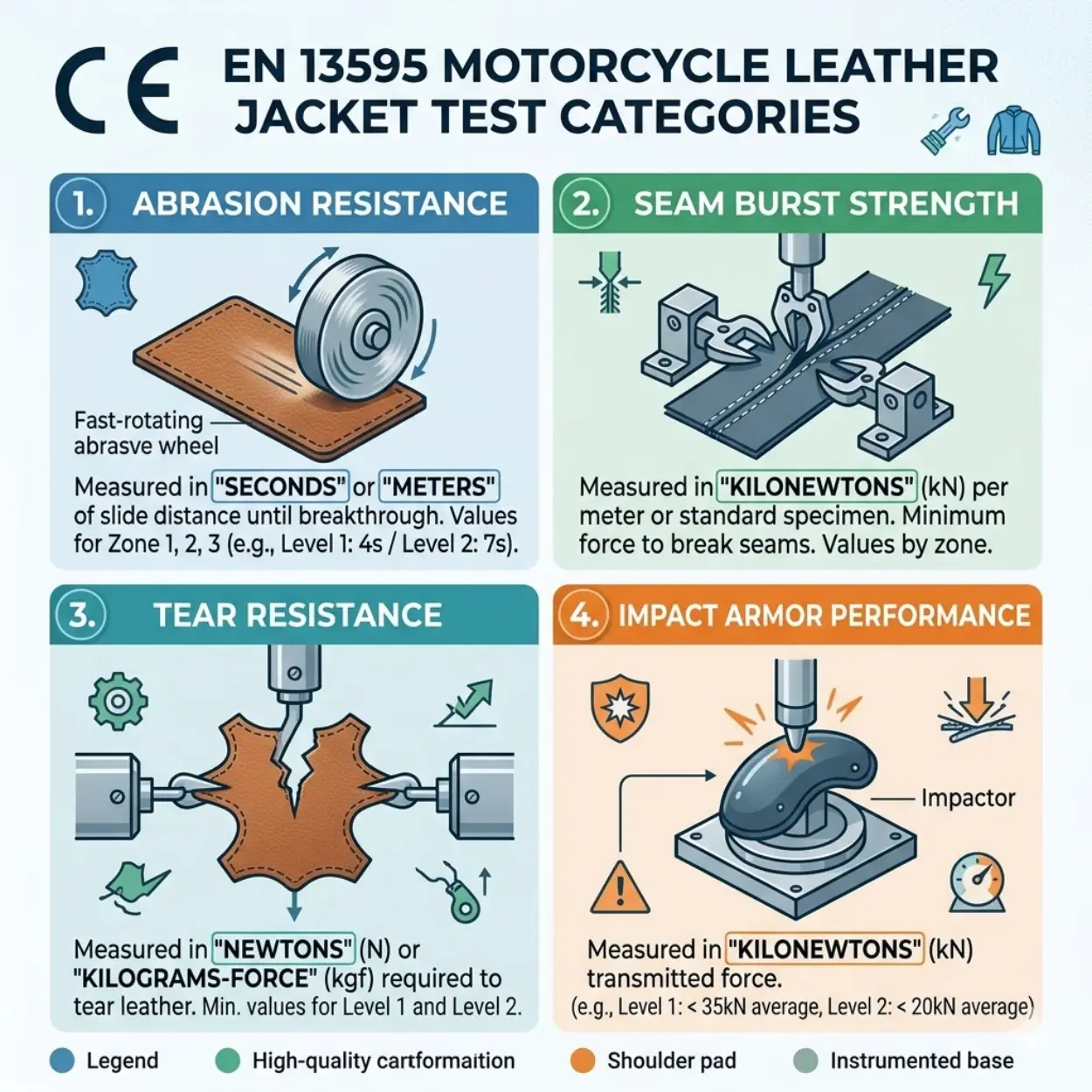
CE marking on a motorcycle jacket means the jacket has been tested against a published European standard. For leather motorcycle jackets, the relevant standard is EN 13595, which defines minimum performance requirements across four specific physical tests. A more recent standard, EN 17092, replaced and expanded on EN 13595 for general motorcycle protective clothing and introduces the AA, A, and B classification system that most riders now encounter in product listings.
Understanding what these standards actually test is the most important piece of information a rider can have, because the marketing around CE certification is often vague in ways that obscure what protection is actually being guaranteed.
The Four Tests in EN 13595 and EN 17092
- Abrasion resistance — How long the material takes to abrade through when pressed against a rotating abrasive drum at a specified force. Measured in seconds. This simulates sliding along asphalt after a fall.
- Seam strength — The force required to tear a seam apart, measured in Newtons. Critical because jacket seams are the most common failure point in a crash.
- Tear resistance — The force required to propagate a tear in the material, measured in Newtons. Determines how easily an initial impact hole in the leather becomes a larger wound.
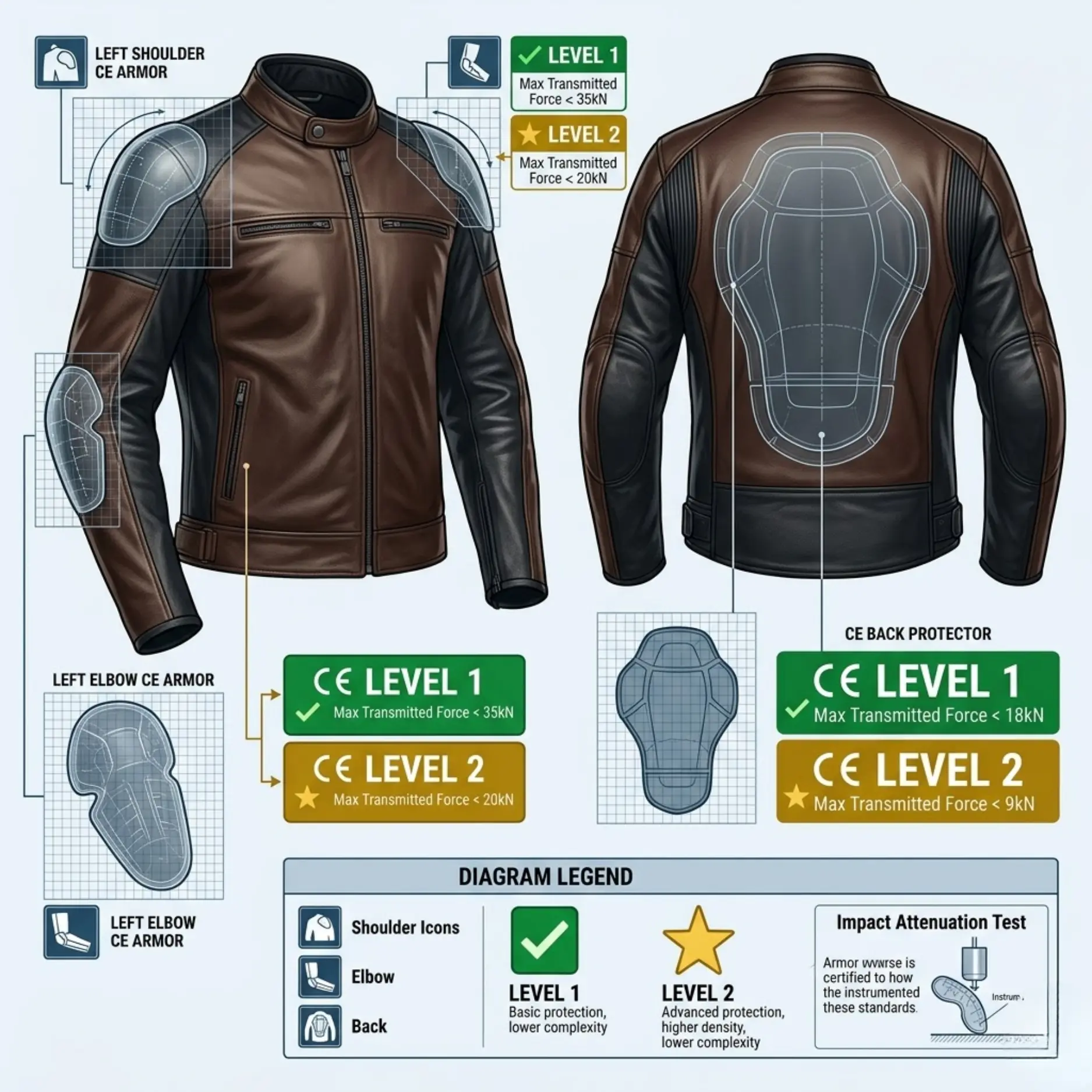
- Impact protection — Tested separately at the armor pockets. CE Level 1 armor must transmit no more than 35kN of peak force. CE Level 2 armor must transmit no more than 20kN. Lower transmitted force means more energy absorbed by the armor before it reaches the rider.
AA, A, and B Ratings Compared: The Real Numbers
Under EN 17092, motorcycle protective jackets are classified as AA, A, or B depending on which combination of tests they pass and at what performance level. These are not marketing grades — they are specific performance thresholds tied to the four tests above. Here are the numbers that define each level.
The abrasion resistance difference between an AA-rated jacket and a B-rated jacket at the shoulder is 7 seconds versus 1.5 seconds — a 367 percent difference in slide duration before the material abrades through. In a real crash sliding at 30mph on dry asphalt, the difference between 1.5 seconds and 7 seconds of abrasion resistance is the difference between road rash at the surface and injury to the underlying tissue.
What Armor to Look For and Exactly Where It Must Sit
A leather jacket can pass the EN 17092 fabric tests at AA level but still provide inadequate impact protection if it does not have CE-certified armor in the correct positions. The armor and the jacket shell are tested and certified separately. Both must meet their respective standards for the jacket to provide genuine motorcycle protection.
Required Armor Positions for a Compliant Motorcycle Jacket
- Both shoulder pockets — Mandatory. Shoulder impact is one of the most common injury sites in a motorcycle crash, so it is something you must consider when looking for motorcycle leather jacket safety ratings. The armor pocket must position the protector over the shoulder joint, not on the collar or upper arm.
- Both elbow pockets — Mandatory. The elbow is the first point of contact in a hands-out fall, which is the instinctive response to falling forward from a bike. Without elbow armor, this instinct becomes a significant injury risk.
- Back pocket — Strongly recommended, not always mandatory in the standard. A back impact protector should be CE Level 1 at minimum for road riding. Back injuries in motorcycle crashes are among the most serious and most preventable with armor in place.
- Chest pocket — Optional in many standards but recommended for track use. Chest impact from handlebar contact or debris is more common at higher speeds.
CE Level 1 vs CE Level 2 Armor
The armor inside the pockets is separately certified under EN 1621-1 (limb armor) and EN 1621-2 (back armor). Level 1 armor must absorb impact energy so that the force transmitted to the body does not exceed 35kN on average. Level 2 armor must keep transmitted force below 20kN. For most road riding, Level 1 armor in all four positions is appropriate. For sport riding above 60mph or track days, Level 2 is the correct specification.
The Real Risk of Riding Without CE Certification
- It cannot verify its abrasion resistance. A non-certified leather jacket may use thin or corrected-grain leather that abrades through in under one second of road contact. CE testing is the only way to know how long your jacket actually lasts in a slide.
- It cannot verify its seam strength. In a crash, jacket seams are under dynamic stress from multiple directions simultaneously. An unverified seam may tear open in a fall, exposing the skin beneath regardless of how strong the leather panels appear when new.
- It has no armor pocket specifications. A jacket without CE armor pockets can be filled with non-certified foam inserts that provide no meaningful impact protection. The pocket location, orientation, and the armor grade itself must all meet the standard to provide protection.
- It cannot provide legal documentation of protection. In US states and jurisdictions where protective gear certification is relevant to insurance claims following a crash, a non-CE-rated jacket cannot demonstrate that it met any safety standard at the time of the accident.
Data from the Motorcycle Safety Foundation indicates that upper body injuries — shoulders, arms, back — account for approximately 61 percent of non-fatal motorcycle crash injuries. CE-rated armor at the shoulder, elbow, and back positions is specifically designed to reduce severity in exactly these impact zones.
“The leather jacket you ride in is not evaluated on how good it looks. It is evaluated on how it performs during the 1.3 seconds of a typical motorcycle crash. The CE standard exists because that 1.3 seconds cannot be replicated in a showroom. The numbers in the standard are the only honest information a rider has about what will happen when it matters.” Marcus Reid, Style and Fashion Expert, SnagLeather
Which Leather Type Best Supports CE Protection?
The CE standard tests the finished jacket material, not the raw hide. However, the leather type and grade directly determine which CE level the finished jacket can achieve. Understanding this relationship helps you read a jacket’s CE rating as a meaningful quality signal rather than just a checkbox.
| Leather Type | Typical Thickness (jacket) | Max CE Level Achievable | Abrasion Performance | Best Use Case |
|---|---|---|---|---|
| Full-Grain Cowhide | 1.0 to 1.4mm | AA (highest) | Excellent | All road riding, motorcycle specific |
| Full-Grain Goatskin | 0.7 to 0.9mm | AA (at higher thickness) | Very good | Road riding, lighter weight priority |
| Top-Grain Cowhide | 0.8 to 1.1mm | A to AA | Good | General road riding |
| Genuine Lambskin | 0.5 to 0.7mm | B only | Limited | Fashion, low-speed urban only |
| Corrected-Grain Leather | Varies | B or uncertified | Poor | Not appropriate for road riding |
| Synthetic / Faux Leather | N/A | Uncertifiable | None | Not appropriate for any motorcycle use |
The practical takeaway is clear: for any motorcycle riding above low-speed urban commuting, you need a full-grain cowhide or full-grain goatskin jacket at a minimum of 0.8mm thickness with CE armor pockets in the correct positions. Everything below that threshold — thinner leather, corrected grain, lambskin, or synthetic — cannot achieve the CE level that road riding demands. For the full breakdown on leather types, see the SnagLeather leather comparison guide.
SnagLeather Safety Specs on Motorcycle Jackets
The motorcycle-oriented jackets in the SnagLeather range — specifically the biker jacket silhouettes in full-grain cowhide — include CE armor pockets at both shoulders, both elbows, and the back. These pockets are sized and positioned to accept CE-certified armor inserts. The leather used in these jackets is full-grain cowhide, which is the correct leather specification for achieving AA-level CE certification.
- CE motorcycle jacket safety is governed by EN 13595 and EN 17092 European standards, which define AA, A, and B protection levels
- AA-rated jackets require 7 seconds of abrasion resistance at the shoulder vs 1.5 seconds for B-rated jackets — a 367 percent difference
- CE Level 1 armor must keep transmitted impact force below 35kN. CE Level 2 must keep it below 20kN
- Required armor positions for a compliant motorcycle jacket are both shoulders, both elbows, and strongly recommended back
- Full-grain cowhide at 1.0mm or above is the correct leather specification for achieving AA-level CE certification
- Upper body injuries account for approximately 61 percent of non-fatal motorcycle crash injuries — the exact zones CE armor is designed to protect
- A jacket without a declared CE rating provides no verified protection standard in a fall
SnagLeather Motorcycle Jackets with CE Armor Pockets
Full-grain cowhide — the leather grade required for AA-level CE certification. CE armor pockets at both shoulders, both elbows, and back. The foundation motorcycle jacket in the SnagLeather range. Free US shipping.
→ View This JacketThe complete SnagLeather biker jacket range including multiple leather types and silhouettes. All motorcycle-specific styles include CE armor pockets. Compare options side by side. Free US shipping on every order.
→ Browse All Biker JacketsFrequently Asked Questions: Motorcycle Leather Jacket Safety Ratings
CE rated on a motorcycle jacket means the jacket has been tested and certified against a published European safety standard — either EN 13595 for leather garments or EN 17092 for general motorcycle protective clothing. CE certification confirms that the jacket material has met minimum performance thresholds for abrasion resistance, seam strength, and tear resistance. The CE mark also applies separately to armor inserts, which must meet EN 1621-1 (limb) or EN 1621-2 (back) standards. A CE-rated jacket without CE-rated armor — or vice versa — does not provide full verified protection.
Yes, CE AA is a higher protection level than CE A. Under EN 17092, AA-rated jackets must withstand 7 seconds of abrasion at the shoulder versus 4 seconds for A-rated jackets. AA also requires higher seam strength (150N vs 120N) and tear resistance (40N vs 25N). For regular road riding at any speed, AA is the recommended minimum. CE A is appropriate for commuting and casual riding. CE B is intended for low-speed urban use only and is not suitable for open-road motorcycle riding.
Yes. Full-grain cowhide and full-grain goatskin leather jackets can achieve CE AA certification under EN 17092 when made from leather at appropriate thickness (1.0mm or above for cowhide) with correctly positioned CE armor pockets and CE-certified armor inserts. Lambskin and thinner leathers can achieve CE B at best. Corrected-grain leather and synthetic leather cannot reliably achieve CE certification at a level appropriate for road riding. CE certification of the jacket shell and CE certification of the armor inserts are separate processes — a jacket needs both to provide complete verified protection.
CE armor must be positioned in pockets at both shoulders and both elbows as a mandatory minimum for a CE-compliant motorcycle jacket. Back armor is strongly recommended and required for higher classification levels. The armor pockets must be located precisely over the impact zones — the shoulder pocket over the shoulder joint (not on the collar or upper arm), and the elbow pocket over the elbow joint. Armor that is incorrectly positioned within the pocket provides reduced protection because the protector does not cover the point of impact in a crash.
CE Level 1 armor (under EN 1621-1 for limbs and EN 1621-2 for back) must keep the average transmitted impact force below 35kN. CE Level 2 armor must keep it below 20kN. Level 2 therefore absorbs more impact energy before transmitting force to the rider’s body. For most road riding, Level 1 armor in all positions is appropriate. For sport riding at higher speeds, track days, or any riding environment where impact forces are likely to be greater, Level 2 armor is the correct specification. Both levels require the armor to be replaced after any significant impact that deforms the protector.
Yes. Full-grain cowhide at 1.0mm or above is the leather specification that achieves AA-level CE certification under EN 17092, which is the highest road protection classification available for motorcycle jackets. The AA rating confirms 7 seconds of abrasion resistance at the shoulder, 150N seam strength, and 40N tear resistance — all measured against the published standard. Full-grain cowhide is the correct leather for road motorcycle use. Goatskin at adequate thickness is also appropriate and offers the advantage of lighter weight at equivalent structural integrity.
CE rating is not legally required to ride a motorcycle in the USA — motorcycle protective gear regulations are generally less prescriptive in the US than in Europe where CE standards are mandatory for gear sold as motorcycle protective clothing. However, CE certification remains the only objective standard that verifies what protection a motorcycle jacket actually provides. Riding without a CE-rated jacket does not break any US law in most states, but it does mean riding without any verified protection standard. For any rider who wants to know rather than guess how their jacket will perform in a crash, CE certification is the minimum information they should demand from their gear.
- CE motorcycle jacket safety is governed by EN 13595 and EN 17092. The AA, A, and B ratings are specific performance levels with published minimum thresholds for abrasion, seam strength, and tear resistance
- AA-rated jackets require 7 seconds of abrasion resistance at the shoulder vs 1.5 seconds for B-rated — a 367 percent difference in slide protection
- CE Level 1 armor must keep transmitted impact force below 35kN. CE Level 2 must keep it below 20kN
- Mandatory armor positions are both shoulders and both elbows. Back armor is strongly recommended for all road riding
- Full-grain cowhide at 1.0mm or above is the correct leather specification for AA-level CE certification
- A jacket without a declared CE rating provides no verified protection in a fall regardless of its appearance or marketing claims
Full-grain cowhide motorcycle jackets with CE armor pockets at shoulders, elbows, and back. Free US shipping on every order.
Shop Motorcycle Jackets →