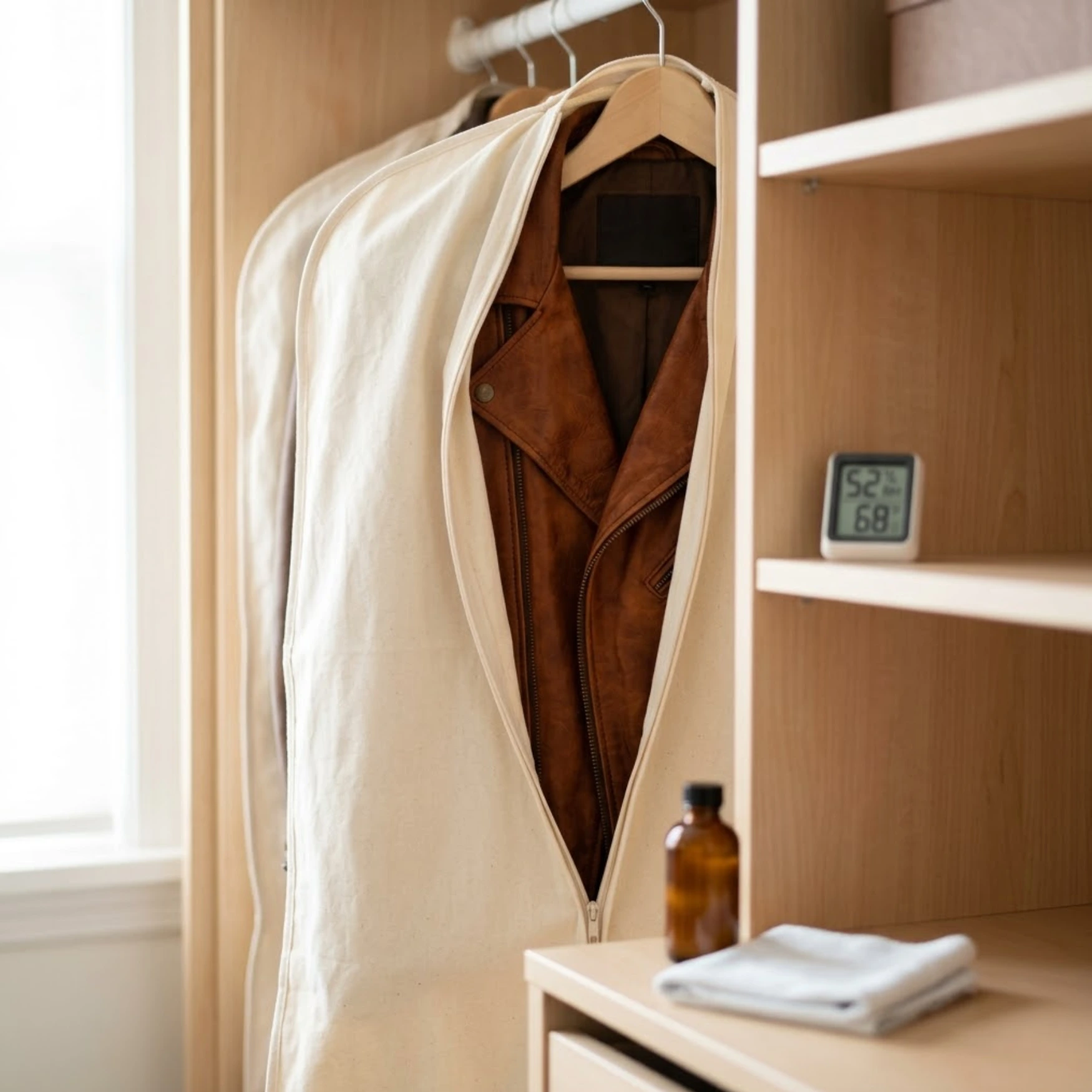
The most common way a leather jacket dies is not through hard use. It dies in a wardrobe over a winter. Folded under other clothes, sealed in a plastic bag, stored in an attic where temperatures swing between 20°F and 100°F, or simply hung on a wire hanger that digs a permanent crease into the shoulder. None of these are dramatic failures. They accumulate slowly and invisibly until one autumn you pull the jacket out and the leather that was supple six months ago has stiffened, cracked at the fold lines, or come out smelling of mould.
This guide gives you everything you need to know how to store a leather jacket correctly: the exact temperature and humidity range, the right hanger and cover, the six-step seasonal storage routine, and the five specific mistakes that cause almost all leather jacket storage damage. Follow this guide once and your jacket will come out of storage in better condition than it went in.
How Do You Store a Leather Jacket Correctly?
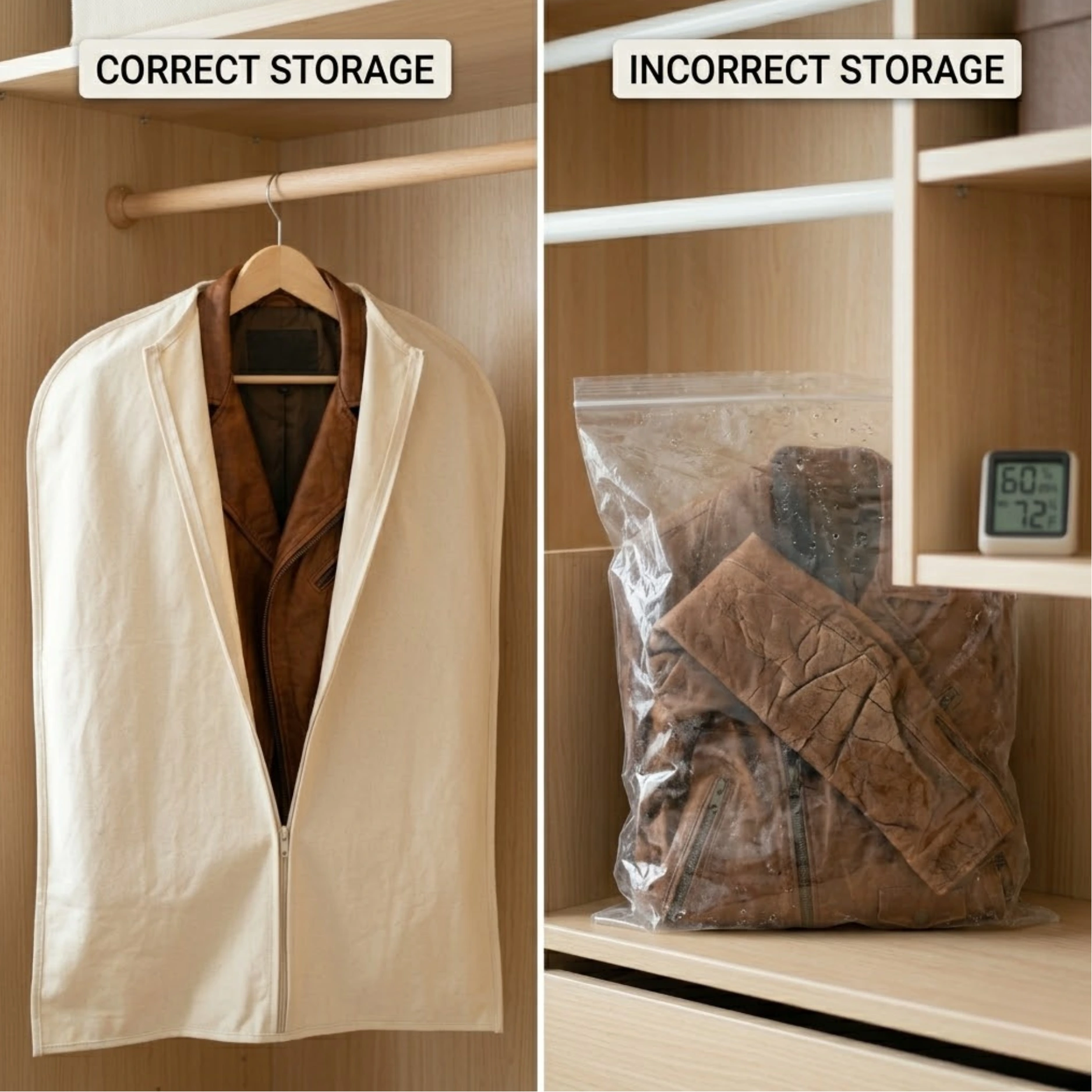
Store a leather jacket in a cool, dry area at 59 to 77°F (15 to 25°C) with 45 to 55 percent relative humidity — conditions outside this range cause cracking, mould, or accelerated drying. Always hang on a wide, padded wooden hanger to preserve shoulder shape. Never fold or compress leather for extended periods. Cover with a breathable cotton garment bag — never plastic, which traps moisture and causes mould within weeks. Condition the leather before any storage period longer than 6 weeks.
→ Browse Genuine Leather Jackets Worth Storing CorrectlyWhy Storage Conditions Matter More Than You Think
Leather is a biological material derived from animal hide. Like all biological materials, it responds to its environment in ways that are measurable, predictable, and permanent once damage occurs. The two environmental variables that matter most for leather storage are temperature and relative humidity — and the relationship between them is more important than either one in isolation.
High temperature accelerates the evaporation of the natural oils in the leather hide, which causes brittleness and cracking. Low temperature does not directly damage leather but dramatically amplifies the effect of low humidity, drying the hide faster than it would at the same humidity level in warmer conditions. High humidity creates the conditions for mould and mildew growth on the leather surface. Low humidity strips the natural oils from the hide even when the leather is not being worn or exposed to sun.
In controlled storage environment testing, full-grain cowhide stored at 86°F (30°C) and 30 percent relative humidity showed measurable surface cracking within 8 weeks. The same leather stored at 68°F (20°C) and 50 percent relative humidity showed no surface damage over the same period. The difference is entirely attributable to storage conditions, not wear.
The Ideal Temperature and Humidity Range: The Exact Numbers
These are not approximate guidelines — they are specific thresholds derived from leather materials science and confirmed by conservation standards used for leather artifacts in museum collections.
What This Means for Common US Storage Locations
- Bedroom wardrobe: Usually ideal. Most climate-controlled US homes maintain 65 to 72°F and 45 to 55% RH naturally. This is the best storage location for most people.
- Basement: Often too humid. Basements in the eastern and midwestern USA frequently run above 60% relative humidity in summer. Use a dehumidifier or avoid basements for leather storage.
- Attic: Almost always wrong. Attics in the US cycle between extreme cold in winter and extreme heat in summer, with low humidity in both conditions. Attic storage causes rapid oil depletion and accelerated cracking.
- Garage: Never appropriate. Garages are uncontrolled environments with wide temperature swings, exposure to vehicle fumes, and unpredictable humidity. Garage storage will damage a leather jacket within one season.
- Climate-controlled storage unit: Acceptable if the unit is specifically maintained at 55 to 75°F and controlled humidity. Not all storage units are. Confirm conditions before using.
Hanger vs Folding: Why the Hanger Choice Matters More Than People Realize
A leather jacket stored hanging on the correct hanger will maintain its shoulder shape, collar structure, and overall silhouette indefinitely. A leather jacket stored folded, stacked, or compressed will develop permanent crease marks at every fold point within 4 to 8 weeks, depending on leather thickness and storage temperature.
This happens because leather has a memory. When compressed at a fold line, the collagen fibers in the hide are forced into a bent orientation. If held in that position long enough under any warmth — including normal room temperature — the fibers re-set in the bent position. Once set, these creases cannot be ironed, steamed, or conditioned away. They become permanent structural deformations in the hide.
The Right Hanger: Three Non-Negotiable Requirements
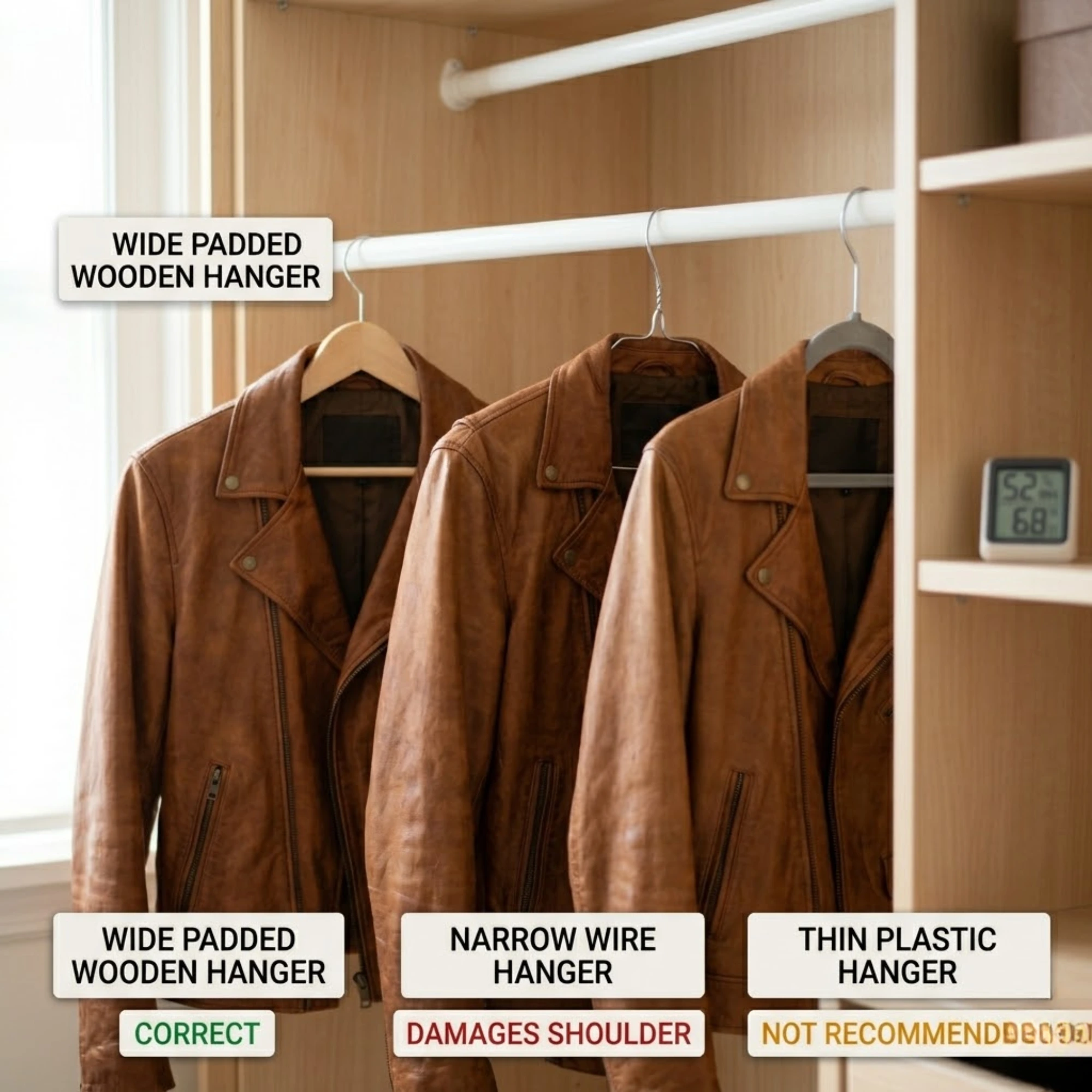
- Width: The hanger must be wide enough to fill the shoulder seam of the jacket without the shoulder panels drooping inward or outward. The standard recommendation is a hanger at least 17 inches wide for a medium jacket. Narrow wire hangers concentrate all the weight of the jacket at a single point and cause permanent indentations at the shoulder seam.
- Padding: Padding distributes the jacket’s weight across a broader area of the shoulder panel. An unpadded wooden hanger is better than a wire hanger but a padded wooden hanger is the correct choice. The padding prevents the hanger edge from pressing a ridge into the leather at the shoulder fold.
- Material: Wooden or wooden-core padded hangers are correct. Wire hangers are not appropriate for leather regardless of width. Plastic hangers are acceptable only if they are wide and smooth — avoid plastic hangers with ridged or grooved surfaces that can mark the leather interior lining.
What to Cover It With — and What to Never Use
The garment bag you choose for long-term leather jacket storage is the second most important storage decision after hanger choice. The material of the bag determines whether the leather breathes correctly during storage or whether it is sealed into a microclimate that promotes mould.
| ✓ Correct Storage Covers | ✗ Never Use These |
|---|---|
| ✓ Breathable cotton garment bag — allows air circulation, prevents dust accumulation, does not trap moisture | ✗ Plastic dry-cleaning bag — traps moisture, causes condensation on the leather surface, creates mould-favorable conditions within days |
| ✓ Unbleached cotton pillowcase — a practical alternative to a garment bag. Breathable, inexpensive, machine washable | ✗ Sealed plastic storage bag — the same problem as a dry-cleaning bag, amplified. Completely airtight storage is the fastest route to mould on leather |
| ✓ Linen garment bag — slightly more breathable than cotton and equally appropriate | ✗ Newspaper or newsprint paper — newsprint contains oils and acids that transfer to leather and cause staining over long storage periods |
| ✓ No cover at all in a clean, dark wardrobe — better than plastic. Dust can be removed. Mould damage cannot be reversed | ✗ Bubble wrap or synthetic foam — traps moisture and static. Creates micro-environments of elevated humidity against the leather surface |
“I have seen more leather jackets ruined by a single winter in a dry-cleaning bag than by ten years of regular riding. The plastic bag is the single most common storage mistake and the one that causes the most irreversible damage. A breathable cotton cover costs three dollars. The jacket it protects is worth ten times that investment.” Marcus Reid, Style and Fashion Expert, SnagLeather
Step-by-Step Seasonal Storage Routine
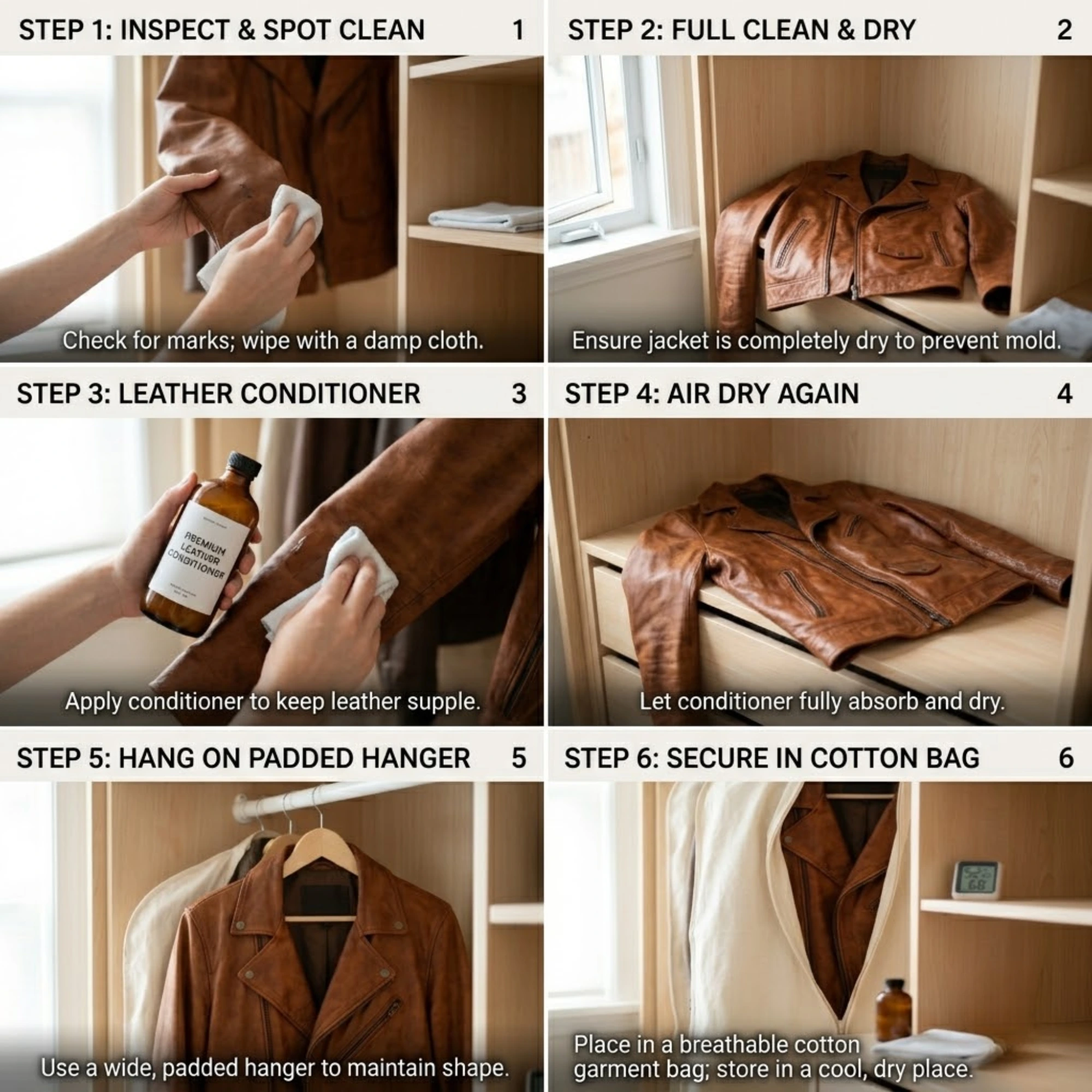
Follow this six-step routine every time you put your leather jacket away for a season. The entire process takes about 45 minutes and ensures the jacket enters and exits storage in optimal condition.
Wipe the entire outer surface with a slightly damp lint-free cloth in long strokes following the grain. Remove any visible dirt, salt deposits, or residue from the season’s wear. Allow the jacket to air dry completely at room temperature before the next step. Never put a damp jacket into storage.
Apply a light coat of appropriate leather conditioner using a clean lint-free cloth in small circular motions. Allow 20 minutes to absorb, then buff with a dry cloth. The leather enters storage with its oils replenished rather than depleted. See the full leather conditioning guide for the complete process. This step is the single most important thing you can do to protect the jacket during any storage period longer than 6 weeks.
Zip the main front zip to approximately halfway — not fully closed, which can stress the zip teeth and the leather at the zipper tape under extended storage. Close all pocket zips fully to prevent the pocket edges from developing a splayed set over time. Snap any hardware closures open rather than snapped, which prevents the snap hardware leaving permanent impressions in the leather where it contacts the hide.
Place the jacket on a wide padded wooden hanger with the shoulder seams sitting exactly on the hanger’s shoulder points. The jacket should hang straight with no pulling or twisting at the collar or side seams. If the jacket twists, the hanger is too narrow for that specific jacket. Use a wider hanger or add padding to the current one.
Slip a breathable cotton garment bag over the hanging jacket. The bag should hang freely around the jacket without compressing the shoulders or sides. Do not tie or seal the bottom of the bag tightly — leave it open or loosely folded to allow air circulation at the base of the jacket.
Place in a climate-controlled wardrobe at 59 to 77°F (15 to 25°C) and 45 to 55 percent relative humidity. Keep away from direct sunlight, heat sources, and exterior walls that may be cold in winter. Check the jacket once a month during storage: open the cotton bag, inspect the surface for any dryness or mould, and condition lightly if the leather feels stiffer than when you stored it. This takes five minutes and prevents the kind of damage that only becomes visible when you pull the jacket out for the season.
The 5 Most Common Leather Jacket Storage Mistakes
- Storing in a plastic bag or dry-cleaning cover. This is the single most common and most damaging storage mistake. Plastic is not breathable. Moisture from the leather itself and from any residual humidity in the storage space accumulates inside the bag, creating conditions for mould within days to weeks. Replace every plastic bag with a cotton alternative before storage.
- Folding the jacket instead of hanging it. Any fold held under weight for more than a few weeks will set into a permanent crease. This is especially true at warmer temperatures. A leather jacket stored folded in a drawer, on a shelf, or under other clothes will develop creases at every compression point that no amount of conditioning will remove.
- Using a wire or narrow hanger. A wire hanger concentrates the jacket’s entire weight at a single narrow point on each shoulder. Over weeks and months this creates a permanent hanger groove across both shoulder panels that visually deforms the jacket silhouette. This damage is most visible on structured jackets and impossible to reverse.
- Storing without conditioning first. A leather jacket that enters storage with depleted oils will exit it significantly drier than when it went in. The storage period — with no natural perspiration or movement to redistribute oils — accelerates oil depletion. Condition before storage, not after. The oil needs to be in the hide during the storage period, not applied in response to the damage already done.
- Storing in a garage, attic, or basement without climate control. Uncontrolled environments expose leather to temperature swings that cause repeated expansion and contraction of the hide at a microscopic level. Over one season, this accelerates cracking at seams and high-flex zones. Over multiple seasons, it destroys leather that would have lasted decades in a climate-controlled wardrobe.
- Ideal leather jacket storage temperature is 59 to 77°F (15 to 25°C)
- Ideal relative humidity for leather storage is 45 to 55 percent — below 40% causes drying, above 60% creates mould risk
- Full-grain cowhide stored at 86°F and 30% RH showed surface cracking within 8 weeks in controlled testing
- Plastic covers trap moisture and can cause mould on leather within days to weeks
- A narrow wire hanger causes permanent shoulder groove damage within one storage season
- Leather should be conditioned before storage, not after — the oil must be present during the storage period
- Garages, attics, and uncontrolled basements are inappropriate storage environments for any genuine leather jacket
Frequently Asked Questions: How to Store a Leather Jacket
The best way to store a leather jacket long term is to condition it first, hang it on a wide padded wooden hanger, cover it with a breathable cotton garment bag, and place it in a climate-controlled wardrobe at 59 to 77°F (15 to 25°C) and 45 to 55 percent relative humidity. Check monthly during storage and apply a light conditioning treatment if the leather feels stiffer than when stored. Never fold, compress, or seal in plastic for any extended period.
No. Folding a leather jacket for storage will cause permanent crease marks at every fold point within 4 to 8 weeks at normal room temperature. Leather has a structural memory — collagen fibers forced into a bent orientation will re-set in that position under sustained compression. These creases cannot be removed by conditioning, steaming, or any other treatment. Leather jackets must always be stored hanging on a wide padded hanger, never folded, stacked, or placed under pressure.
No. Plastic bags trap moisture against the leather surface, creating a humid microclimate that promotes mould growth. This can happen within days in warm conditions. A plastic dry-cleaning bag is one of the most common causes of mould damage on leather jackets in storage. Always use a breathable cotton garment bag, a linen cover, or no cover at all rather than any plastic or synthetic covering material.
In summer, the primary storage risks for leather jackets are high temperature and high humidity. Store in an air-conditioned area that maintains temperature below 77°F (25°C) and relative humidity below 55 percent. If you live in a humid climate like the US Southeast, use a small dehumidifier in the storage wardrobe or add silica gel moisture absorbers to the space. Check the jacket monthly for any signs of mould — white or grey surface spots — and treat immediately if found by wiping with a diluted white vinegar solution on a clean cloth.
Before. Conditioning a leather jacket before storage ensures the hide enters the storage period with its oil content replenished. During storage, no natural activity replenishes leather oils, and even in a correctly controlled environment some oil migration and evaporation occurs over months. A pre-storage conditioning treatment is the insurance that protects the leather throughout the storage period. Conditioning after storage is damage repair rather than prevention. For the full routine, see the SnagLeather conditioning guide.
Attic storage almost always damages leather jackets because attics in the USA cycle between extreme cold in winter and extreme heat in summer, often with low humidity in both conditions. This temperature cycling causes repeated microscopic expansion and contraction of the leather hide, accelerating cracking at seams and high-flex areas. The low humidity typical of attics during cold months rapidly depletes the natural oils in the leather. A single winter in an uninsulated attic can cause damage equivalent to years of heavy wear in correct storage conditions.
Yes, provided the wardrobe is climate-controlled, the leather jacket is not compressed between other garments, and it is hung on a wide padded hanger with enough clearance to hang freely. The biggest risk from shared wardrobe storage is compression — if other garments are pressing against the leather jacket from both sides, fold marks will develop at the contact points over time. Give the leather jacket at least 2 to 3 inches of clear space on both sides. A breathable cotton garment bag will protect it from dust and incidental contact with other items.
- Store at 59 to 77°F (15 to 25°C) and 45 to 55 percent relative humidity — these are the two most important storage variables
- Always hang on a wide, padded wooden hanger. Never fold, stack, or compress a leather jacket for extended periods
- Cover with a breathable cotton garment bag. Never use plastic, sealed covers, or synthetic materials
- Condition before storage, not after — the leather needs its oils present during the storage period
- Garages, attics, and uncontrolled basements are inappropriate storage environments for genuine leather
- Check the jacket monthly during storage. Five minutes of inspection prevents the damage that only becomes visible at the end of the season
Genuine leather jackets worth storing correctly. Full-grain cowhide, lambskin, goatskin, and horsehide across men’s and women’s styles. Free US shipping on every order.
Shop Genuine Leather Jackets →