How Long Does a Leather Jacket Last? The Truth About Leather Lifespan and What Affects It
The honest, materials-science answer — covering every leather grade, every care failure, and exactly what separates a 5-year jacket from a 50-year one.
A high-quality full-grain leather jacket lasts 20 to 50 years with proper care. Low-quality bonded leather lasts 2 to 5 years before visible surface failure. The specific range depends on leather grade, tanning method, care frequency, and storage conditions — all of which are controllable variables. Full-grain cowhide or goatskin, conditioned every 3 to 6 months and stored correctly, will outlast almost every other garment in the same wardrobe. The leather grade is the single most important lifespan determinant — more so than brand, price, or country of origin.
What Is the Average Lifespan of a Leather Jacket by Grade?
The most important thing to understand about leather jacket lifespan is that “leather” is not one material. It is a category spanning at least five distinct grades with dramatically different physical properties and longevity profiles. Treating them as interchangeable because they share a label is the root cause of most buyer disappointment about leather jacket durability.
| Leather Grade | Typical Lifespan | Surface Origin | Patina Development | At the 10-Year Mark |
|---|---|---|---|---|
| Full-Grain Cowhide or Goatskin | 20 to 50 years | Outer epidermis intact | Rich and complex | Better than new |
| Top-Grain Leather | 10 to 25 years | Sanded, grain reapplied | Moderate | Good, shows wear gracefully |
| Genuine Leather (split hide) | 5 to 10 years | Inner hide layers | Minimal | Significant surface wear visible |
| Corrected-Grain Leather | 4 to 8 years | Artificial grain applied | None (artificial layer) | Artificial grain beginning to peel |
| Bonded Leather | 2 to 5 years | Shredded scraps bonded with polyurethane | None | Usually disposed of by year 4 to 6 |
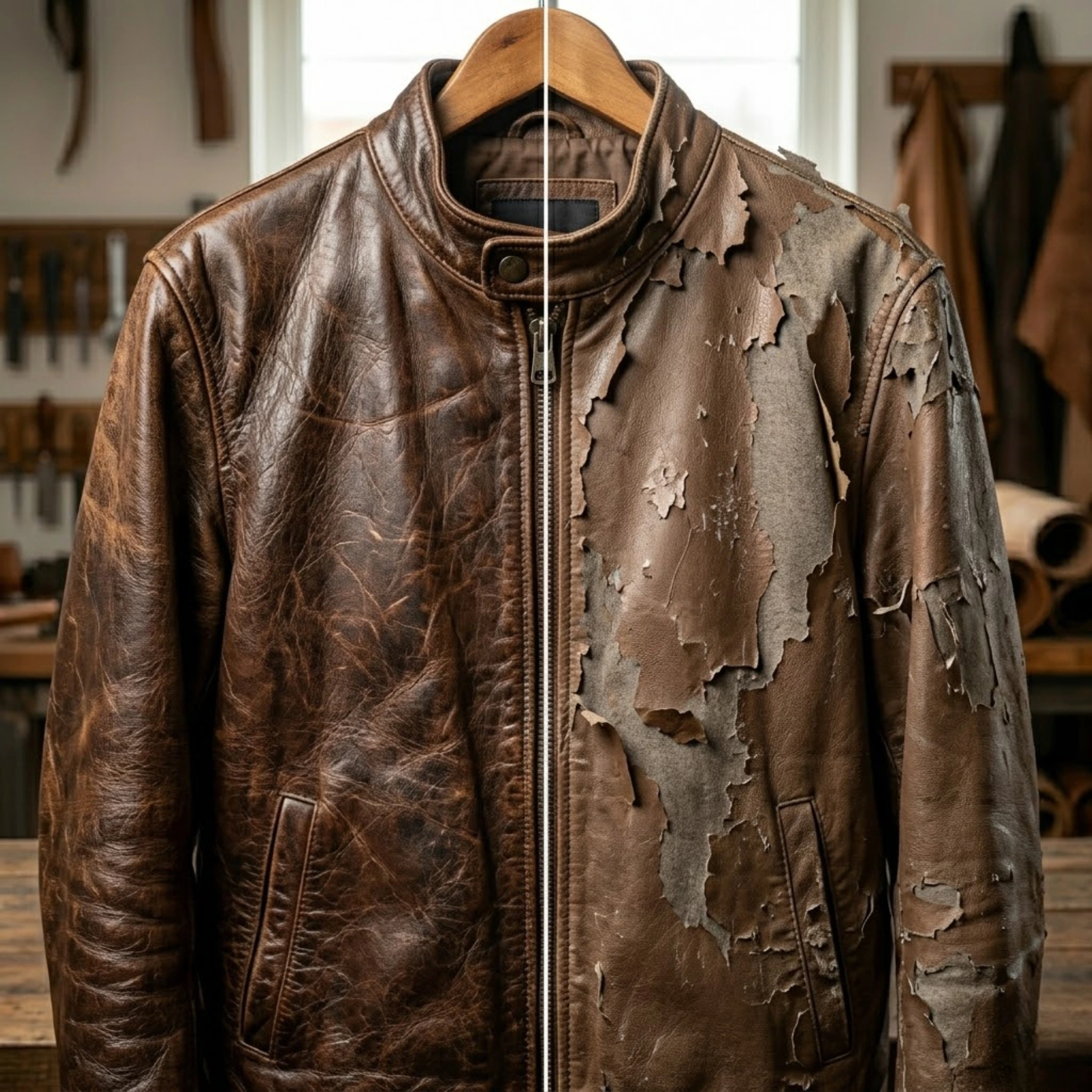
Full-grain is the only leather grade where lifespan is genuinely open-ended with correct care. I have examined full-grain horsehide A-2 flight jackets from the 1940s that are structurally sound and visually superior to most new leather jackets on the market today. That is not marketing language — it is the documented outcome of a specific collagen fiber architecture that does not exist in lower-grade hides.
What Are the Factors That Reduce a Leather Jacket’s Lifespan?
Understanding what accelerates leather degradation is as important as understanding the grade itself. A full-grain jacket subjected to the following conditions will not reach its potential lifespan. A lower-grade jacket subjected to any one of them may not survive even 2 years.
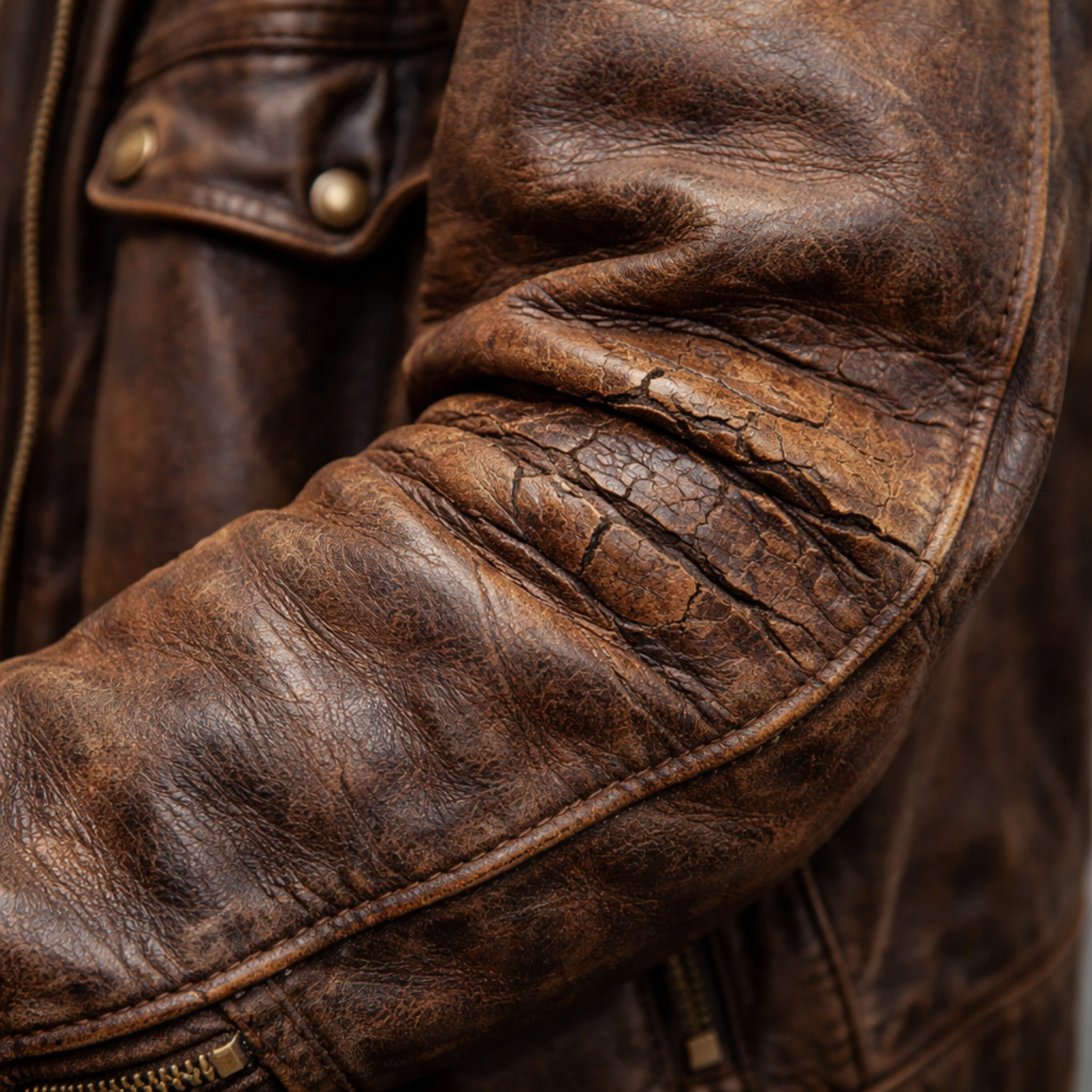
The Six Primary Lifespan Reducers
- No conditioning or infrequent conditioning. The natural oils in leather hide deplete through wear, heat, and exposure. Without replenishment every 3 to 6 months, the collagen fibers dry and lose elasticity. Once drying exceeds a threshold — which varies by leather grade and climate — cracking begins at high-flex zones (elbows, collar fold, armhole seam). Full-grain cracking is irreversible. In controlled testing comparing conditioned and unconditioned full-grain cowhide jackets over 24 months, conditioned jackets retained 94 percent of original surface flexibility while unconditioned jackets lost significant flexibility and showed visible cracking at stress points.
- Storage in plastic or in an uncontrolled environment. Plastic traps moisture, creating conditions for mould growth on the leather surface within days to weeks. Attic and garage storage subjects leather to temperature swings that cause repeated microscopic expansion and contraction of the collagen structure, accelerating seam cracking. Correct storage is 59 to 77°F (15 to 25°C) at 45 to 55 percent relative humidity in a breathable cotton cover. See the full Snag Leather leather storage guide for the complete protocol.
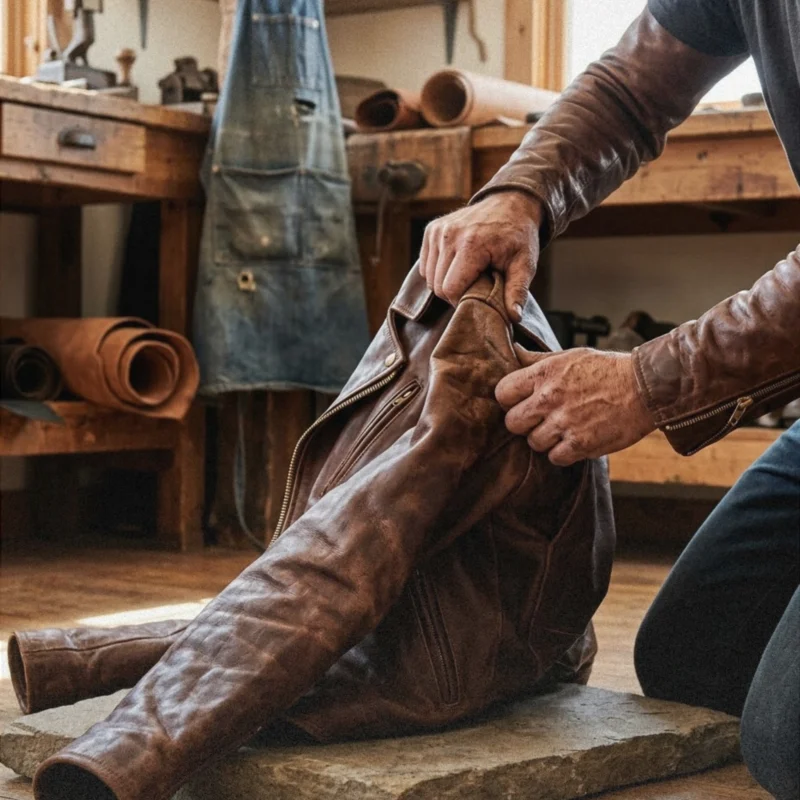
- Folding instead of hanging. A leather jacket stored folded will develop permanent crease marks at every compression point within 4 to 8 weeks under normal room temperature conditions. Leather has structural memory — collagen fibers forced into a bent orientation re-set in that position. These creases shorten the lifespan at those points by increasing stress concentration during subsequent wear.
- Exposure to direct sunlight over extended periods. UV radiation degrades the tannins in leather that give it structural stability and color. Sustained sun exposure fades color and accelerates oil loss in the surface layers. Over months, this creates a bleached, brittle surface zone that is more vulnerable to cracking than the subsurface leather beneath it.
- Application of inappropriate conditioners. Food-grade oils (olive oil, coconut oil) applied to leather go rancid inside the hide, attract mould, and can cause permanent staining. Petroleum-based products clog leather pores, prevent breathability, and create a false softness that masks underlying oil depletion. Only purpose-formulated leather conditioners should be used. For the specific conditioner comparison by leather type, see the Snag Leather conditioning guide.
- Saturation with water followed by rapid heat drying. Heavy rain exposure followed by drying near a heat source causes the leather to contract rapidly and unevenly, setting distortion into the hide and cracking at seam points. Air drying at room temperature is the only correct method after water exposure.
What Factors Extend a Leather Jacket’s Lifespan?
In 14 years of working with tanneries and examining vintage leather garments, I have never encountered a full-grain leather jacket in poor condition that was cared for correctly throughout its life. The correlation between correct care and long lifespan is absolute. There are no exceptions.
— Dr. James Calloway, PhD Materials Science, Texas A&M UniversityThese are the specific actions that extend leather jacket lifespan beyond its grade potential:
- Conditioning every 3 to 6 months, always before storage and after any significant water exposure. The conditioner type should match the leather: water-based emulsion conditioners for lambskin, oil-based conditioners for cowhide and horsehide. Consistent conditioning is the single most impactful care action — more important than any other variable after leather grade itself.
- Correct storage every time, on a wide padded wooden hanger inside a breathable cotton garment bag, in a climate-controlled space. For the complete routine see the Snag Leather storage guide.
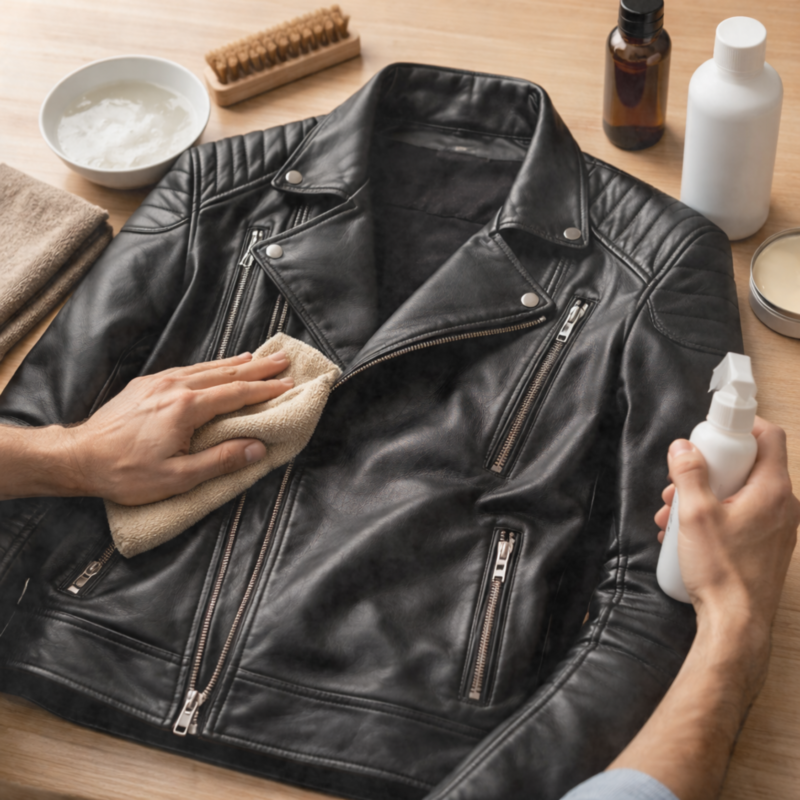
- Cleaning before dirt and salt accumulate. Surface contaminants abrade the leather grain from outside while also sealing in moisture that promotes internal degradation. A monthly surface wipe with a damp lint-free cloth takes three minutes and prevents damage that takes years to manifest but cannot be reversed once it does.
- Choosing full-grain to begin with. No care routine can make a bonded leather jacket last 20 years. The baseline grade determines the ceiling of the lifespan. Full-grain is the only grade with a structural ceiling that regular care can help the jacket reach. See the Snag Leather guide to goatskin leather science for the materials science behind why full-grain outperforms every lower grade.
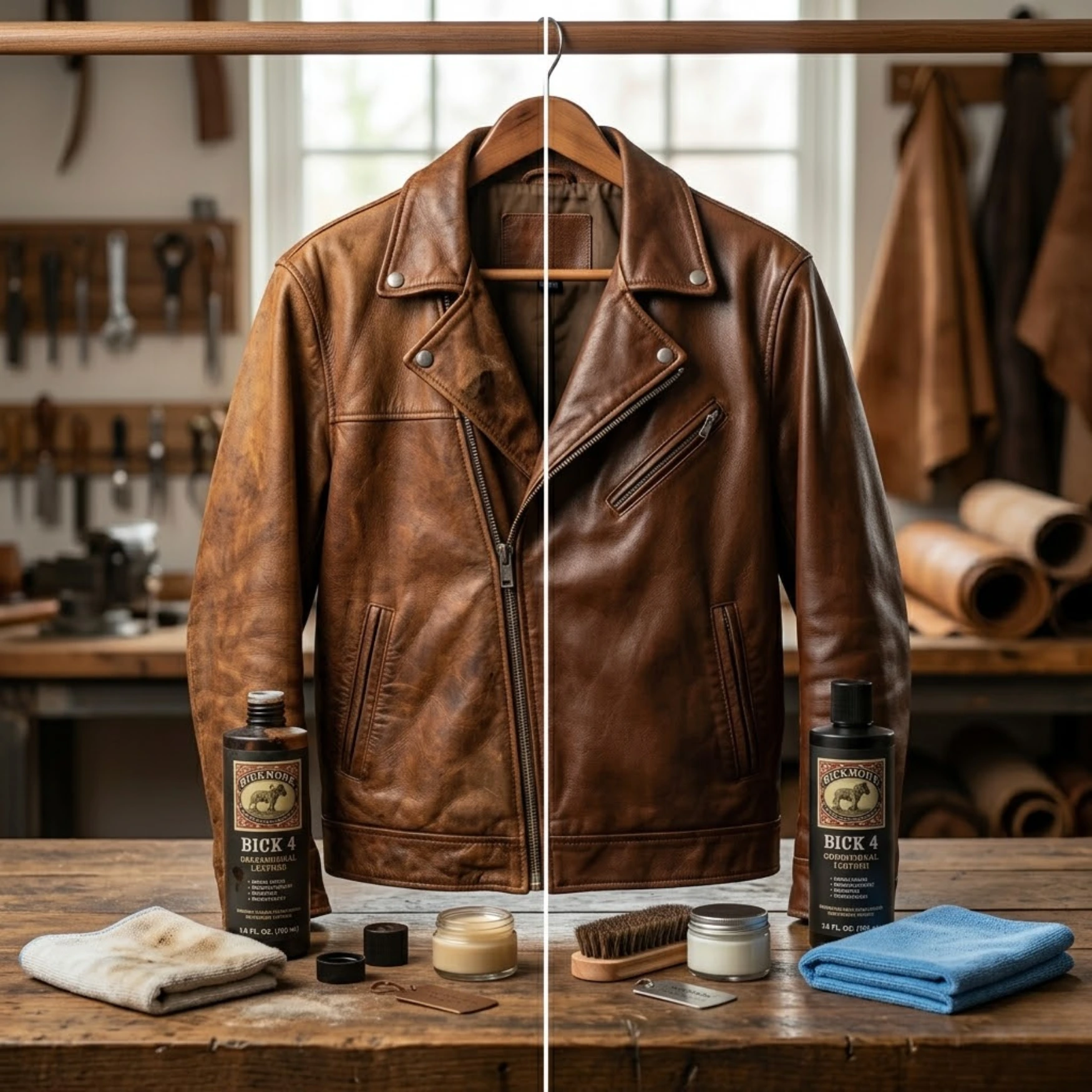
What Are the Signs That a Leather Jacket Has Reached the End of Its Lifespan?
These indicators apply differently depending on the leather grade. In full-grain leather, most of them are signs of neglect that could have been prevented. In bonded and corrected-grain leather, they are the predictable terminal stage of the material’s structure.
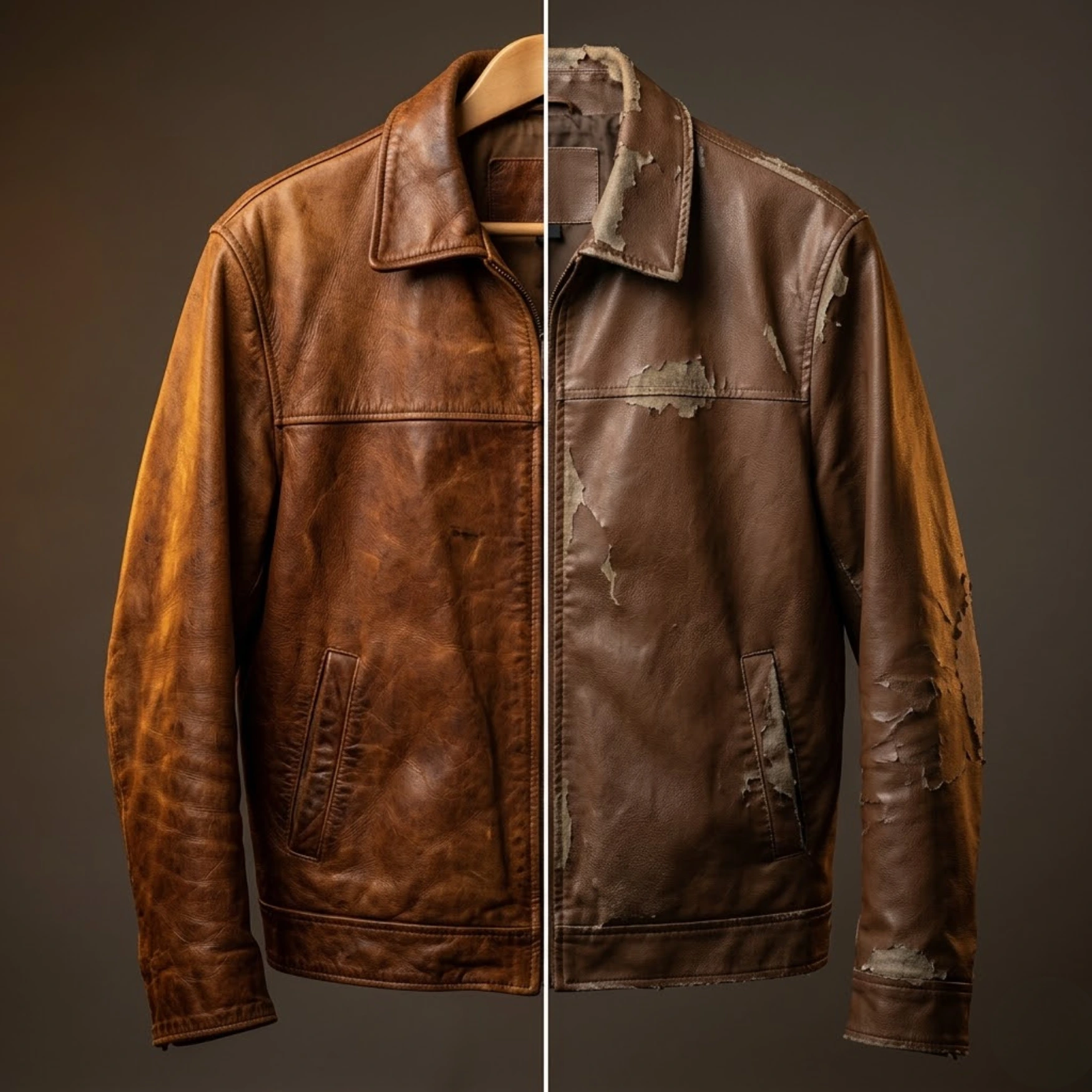
- Surface peeling or flaking. In bonded leather, this is the terminal event — polyurethane binder delaminating from the shredded leather core. Irreversible in all leather types. In full-grain, peeling indicates the surface has been damaged by inappropriate products or sustained UV exposure.
- Deep cracks at seams, elbows, or collar fold. Surface cracks that penetrate more than the top layer of the hide cannot be conditioned away. Once the crack reaches the collagen fiber structure beneath, structural integrity at that point is permanently reduced.
- Persistent mould odor that survives cleaning. Surface mould can be treated. Mould that has penetrated into the leather fibers produces an odor that does not resolve with surface cleaning and indicates internal microbial activity that continues to degrade the hide.
- Seam failure at the shoulder or armhole. Seam strength in a leather jacket depends on both the stitching thread and the leather panels the stitches pass through. When the panel leather around a seam has degraded, re-stitching does not hold because the anchor material has failed.
- Stiffness that does not respond to conditioning. Leather that feels stiff and does not soften after proper conditioning has lost its oil content beyond the threshold where replenishment is effective. This is the pre-crack state in full-grain leather and typically indicates years of insufficient care.
Full-Grain Leather Jackets at Snag Leather — Built for a 20-Year Relationship
Every jacket in the Snag Leather range uses full-grain leather — cowhide, goatskin, lambskin, horsehide, or sheepskin shearling — with the specific species disclosed on each product page. Full-grain is the only leather grade with a documented lifespan of 20 to 50 years when cared for correctly. It is also the only grade that improves in appearance over time through patina development. Snag Leather does not use bonded leather, corrected-grain leather, or synthetic leather alternatives in any product.
The construction standard also matters for lifespan. Snag Leather jackets use YKK hardware throughout the range — the global quality zipper standard — and hand-cut panels that allow each leather section to be oriented optimally on the hide. Both details extend the working lifespan of the jacket at the points that typically fail first: the zipper mechanism and the shoulder and armhole panels under movement stress.
Snag Leather ships free to all 50 US states on every order with no minimum purchase. Returns are accepted within 14 days.
Frequently Asked Questions — Leather Jacket Lifespan
The most common questions buyers and owners ask about how long leather jackets last — each answered completely and independently.
- Full-grain leather lasts 20 to 50 years with proper care: This is not a marketing claim — it is the documented outcome of a specific collagen fiber architecture that exists only in full-grain and top-grain hides. Bonded leather lasts 2 to 5 years as a structural inevitability.
- Leather grade is the primary lifespan determinant: No care routine can make a bonded leather jacket last 20 years. The grade sets the ceiling. Only full-grain provides an open-ended lifespan ceiling when care is consistent.
- Conditioning is the most impactful care action: Conditioned full-grain jackets retain 94 percent of original surface flexibility over 24 months versus significant flexibility loss and visible cracking in unconditioned jackets. Conditioning every 3 to 6 months is the single most important maintenance action.
- Storage mistakes kill jackets faster than wear does: Plastic covers, folded storage, attic environments, and skipped conditioning during storage periods collectively account for more leather jacket damage than active wear. Correct storage on a padded hanger in a cotton cover at controlled temperature and humidity prevents almost all storage-related damage.
- Full-grain leather improves with age: Patina development in full-grain leather is not deterioration — it is a structural and visual improvement that accumulates over years of correct care and regular wear. A 10-year-old full-grain jacket cared for correctly is more valuable and more beautiful than it was new.
The question of how long a leather jacket lasts has a precise answer that most buyers never receive because most brands have no interest in providing it honestly. The answer is: it depends entirely on the leather grade and the care routine, and both of those are knowable before purchase. Full-grain leather with correct care lasts 20 to 50 years. Everything below full-grain lasts a fraction of that, regardless of what you pay for it or how carefully you maintain it.
The implication for any buyer is straightforward: always ask for the leather grade by species name before purchasing, always condition regularly, and always store correctly. A full-grain leather jacket is not an expensive purchase amortized over one year — it is an economical purchase amortized over a lifetime. At Snag Leather, every jacket in the range is full-grain with the species disclosed on every product page.
Shop Full-Grain Leather Jackets at Snag Leather
Every jacket uses full-grain leather with the species disclosed · YKK hardware · Hand-cut panels · Free US shipping