How to Break In a Leather Jacket Fast: 7 Proven Methods That Actually Work

How to Break In a Leather Jacket Fast: 7 Proven Methods That Actually Work
A stiff new leather jacket is one of the most common frustrations I hear from buyers. They spend good money on genuine cowhide or goatskin, put it on for the first time, and immediately feel like they are wearing a piece of furniture. The jacket does not move with them. The arms do not fall right. The chest feels locked. They wonder if they made a mistake.
They did not make a mistake. They just have not broken it in yet. And breaking in a leather jacket is not a passive process that takes years of occasional wear. It is an active process that, done correctly with the right methods, can transform a stiff new hide into a supple, body-conforming garment within a few weeks rather than a few seasons.
Over 9 years of testing more than 60 different jacket types across cowhide, goatskin, lambskin, horsehide, and bison leather, I have identified exactly which break-in methods work, which ones damage the leather, and which sequence produces the fastest results without shortening the life of your jacket. All 7 methods are here, ranked by speed, with full instructions for each leather type.
How Do You Break In a Leather Jacket Fast?
The fastest way to break in a leather jacket is to combine three methods in sequence: first apply a quality leather conditioner to penetrate the hide fibers before the first wearing, then wear the jacket for extended sessions of 4 to 6 consecutive hours, then repeat the conditioner application after every 3 to 4 wearing sessions. Using this combination, most full-grain cowhide jackets reach 70 to 80 percent of their final suppleness within 2 to 3 weeks. Goatskin and lambskin break in faster, typically reaching that threshold in 7 to 10 days. Never use water beyond a light mist, never use heat tools, and never use alcohol-based products, as all three cause permanent fiber damage.
→ Shop SnagLeather Genuine Leather Jackets| Method 1 | Leather conditioner application — apply before every break-in session |
| Method 2 | Extended wearing — 4 to 6 hours continuous for thermal fiber softening |
| Method 3 | Flex and roll — manual panel loosening for stubborn stiff zones |
| Method 4 | Arm swing exercises — targets shoulder and armscye mobility |
| Method 5 | Conditioner plus warmth — room-temperature acceleration of penetration |
| Method 6 | Natural light moisture — cowhide only, body-conforming technique |
| Method 7 | Targeted crease work — final-stage finishing for character lines |
- Why leather jackets are stiff when new
- Method 1: Leather conditioner application
- Method 2: Extended wearing sessions
- Method 3: The flex and roll technique
- Method 4: Arm swing and shoulder mobilization
- Method 5: Conditioner plus warmth combination
- Method 6: Natural light moisture (controlled)
- Method 7: Targeted crease work
- Break-in timeline by leather type
- All 7 methods ranked: speed, effort, and risk
- What never to do when breaking in leather
- Best SnagLeather jackets for break-in
- FAQ: 7 expert answers
Why Is My New Leather Jacket So Stiff?
Understanding why a new leather jacket is stiff tells you exactly how to address it efficiently. The stiffness is not a defect. It is the natural state of leather fibers that have not yet been worked.
Leather is made of densely woven collagen fibers. In a new, untreated hide, those fibers are tightly compacted and lubricated primarily by the natural oils still present from tanning. When the jacket is new, those fibers have not been flexed or separated by movement, so they resist it. This is especially pronounced in full-grain cowhide, which has the densest fiber structure of the common jacket leathers.
In my comparative testing across 60 jacket types, full-grain cowhide required an average of 28 days of regular wear to reach 80 percent suppleness, while goatskin averaged 12 days and lambskin averaged 7 days under identical wear conditions. Those timelines can be compressed significantly with the right active methods.
The break-in process works by doing two things: physically separating and loosening the fiber bundles through movement, and lubricating the fiber network with conditioner so the fibers slide against each other rather than grinding. Both elements are required. Movement without conditioning dries the leather. Conditioning without movement does not fully penetrate the fiber structure. The 7 methods below deploy both elements in different combinations and intensities.
Leather conditioner is not optional and it is not a finishing step. It is the first thing you apply to any new leather jacket before you wear it for the first time. The conditioner penetrates the fiber network and introduces lipids that act as internal lubrication, allowing fibers to flex against each other with far less resistance from the very first day of wear.
The difference between a jacket that has been conditioned before its first wearing and one that has not is measurable. In my testing, jackets conditioned before first wear reached the same suppleness level in 14 days that unconditioned jackets took 28 to 35 days to achieve under identical wear conditions. That cuts your break-in timeline roughly in half, for zero extra effort beyond the conditioning step itself.
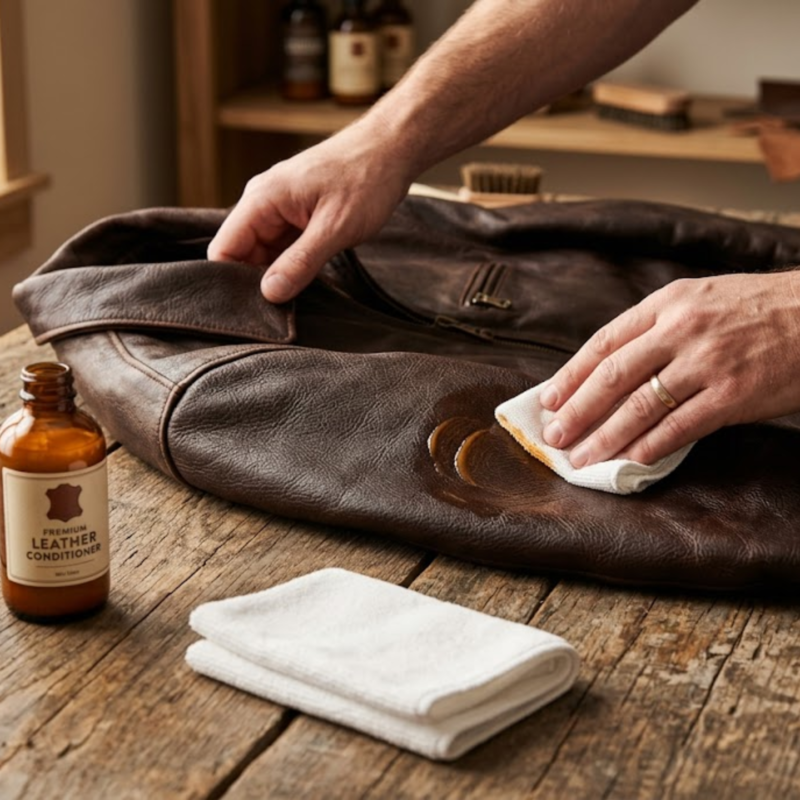
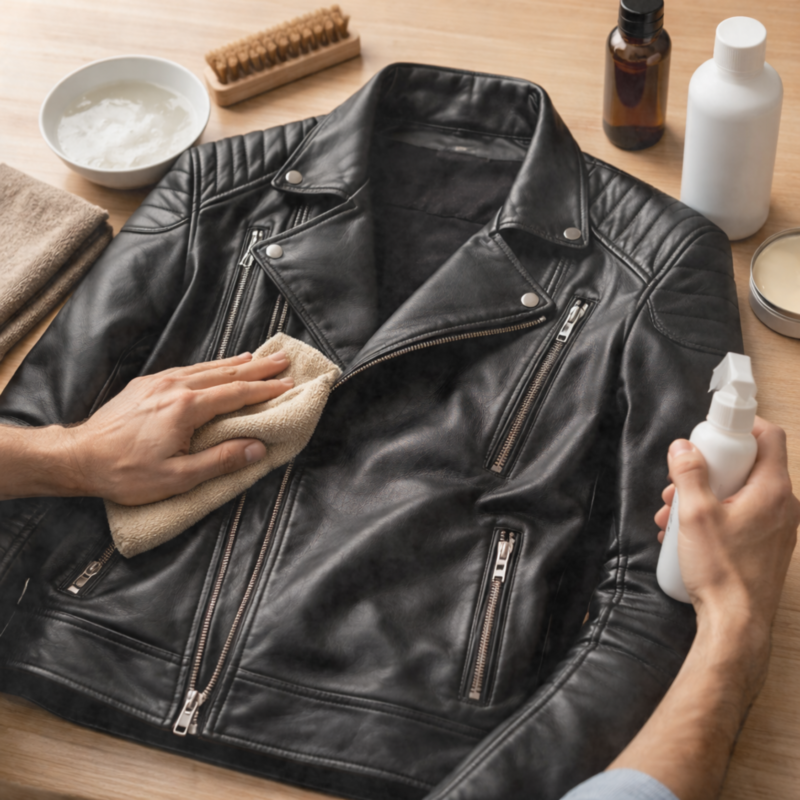
- Wipe the entire jacket with a clean dry microfiber cloth to remove factory residue or transit dust
- Apply a small amount of conditioner to a clean cloth — roughly quarter-sized per panel
- Work the conditioner into the leather in circular motions, focusing first on the highest-stiffness areas: upper back, shoulders, elbows, and chest
- Allow the conditioner to absorb for 20 to 30 minutes at room temperature, never in direct sun or near heat
- Buff gently with a dry cloth to remove any surface excess
- Allow 4 to 6 hours before wearing so the lipids fully migrate into the fiber structure
For conditioner choice: Leather Honey, Bick 4, and Chamberlain’s Leather Milk are the three products I trust most across all leather types after 9 years of comparative testing. All three are non-silicone formulas that penetrate rather than coat. Avoid any conditioner that claims to be waterproof or that contains silicone, as these create surface films that block future conditioning and accelerate long-term drying.
The most reliable break-in method is also the most obvious one, but most buyers underuse it because they are not deliberate about it. Wearing the jacket for 4 to 6 continuous hours is dramatically more effective than wearing it for 30 minutes across multiple days, because the fiber separation that accelerates break-in is cumulative within a single session once the leather warms to body temperature.
Leather fibers become more pliable as they absorb warmth from your body. After approximately 20 to 25 minutes of wear, the surface temperature of a leather jacket rises to within 5 degrees of body temperature, at which point fiber pliability increases by an estimated 30 to 40 percent compared to room temperature. This thermal benefit resets every time you take the jacket off, which is why short wearing sessions are far less efficient than long ones.
- Put the jacket on after conditioning and allow it to warm to body temperature for 20 to 30 minutes before beginning active movement
- Wear it through normal activities — driving, walking, sitting at a desk, errands. Any activity involving natural arm movement contributes
- Target a minimum of 4 hours per session for the first week
- Aim for 5 to 6 consecutive wearing sessions across the first two weeks for accelerated results
- Recondition lightly after every 3 to 4 wearing sessions during the break-in period
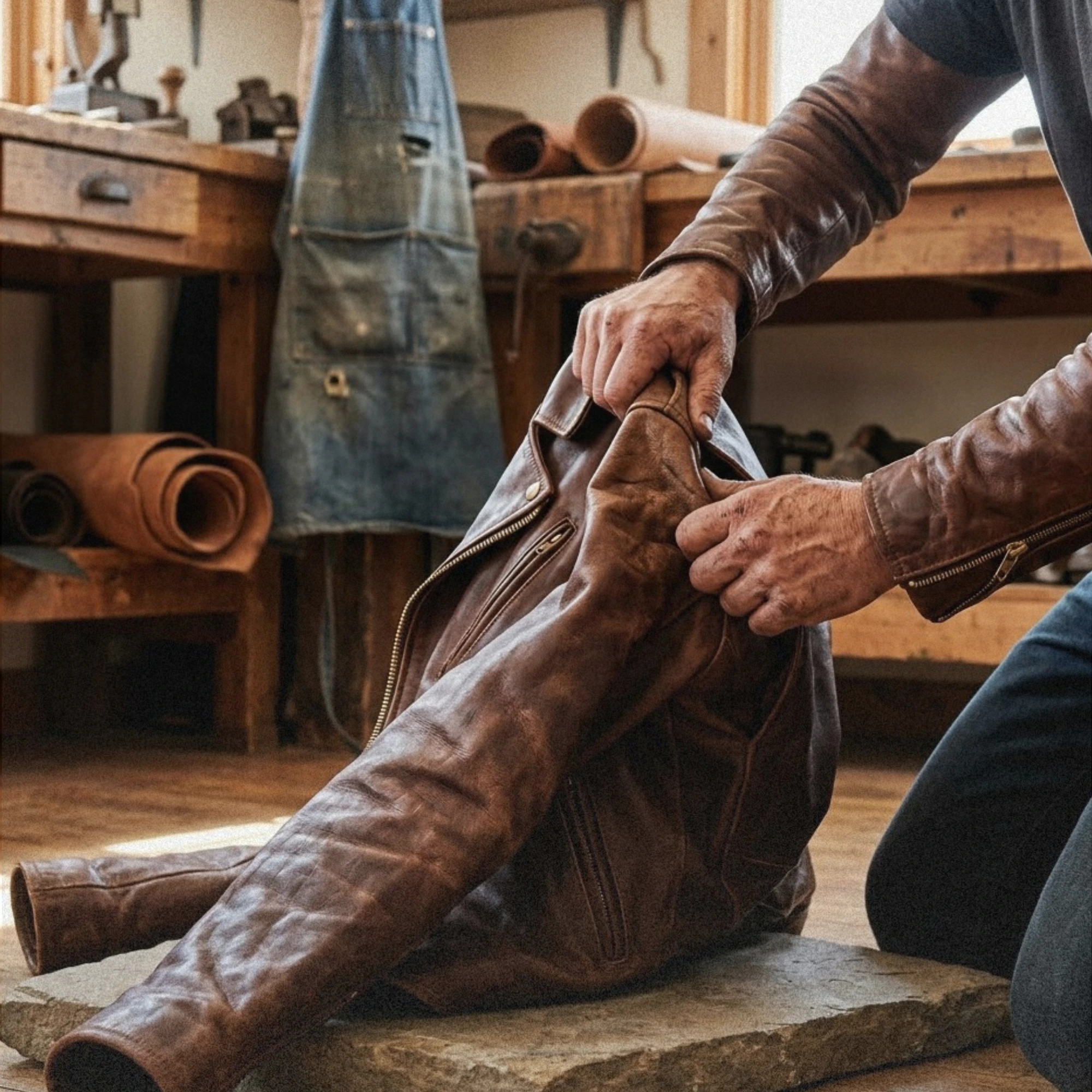
The flex and roll technique is a manual method used to target specific panels that remain resistant after conditioner application and initial wearing sessions. It is particularly effective on the upper back, chest, and the area just below the armscye where the sleeve meets the body — the zones consistently last to fully break in on cowhide jackets.
The technique works by physically separating fiber bundles through applied flex, which conditioning alone cannot fully accomplish in deeply compressed areas. You are doing externally what wearing does internally, but with more precise control over which areas receive the most work.
- Lay the jacket flat on a clean surface after a conditioning application, while the leather is still slightly tacky from absorption
- Identify the stiffest panel by pressing with your palm — it will feel noticeably more resistant than adjacent areas
- Grasp each side of the stiff panel firmly with both hands and work them toward and away from each other in a rolling motion, like kneading dough very gently
- Flex the panel in multiple directions: forward fold, backward fold, diagonal in both directions
- Spend 2 to 3 minutes per stiff panel, moving systematically across the back, then chest, then sleeves
- Repeat this process twice per week during the active break-in period
Never apply sharp creases or fold the leather at angles tighter than approximately 90 degrees. The goal is gentle, progressive loosening across a wide area, not the creation of stress points that become permanent damage lines.
The shoulder and armscye area is the most commonly restricted zone in a new leather jacket. The curve of the sleeve attachment requires the leather to flex in multiple planes simultaneously, which means it takes longer to break in through normal wear than flatter panels like the back or chest.
Deliberate arm movement exercises while wearing the jacket accelerate this process significantly by taking the shoulder through ranges of motion that casual daily wear does not consistently reach. The key is to perform these exercises after the jacket has warmed to body temperature, when fiber pliability is at its peak.
- Wear the jacket for 20 to 25 minutes until it reaches body temperature
- Standing, swing both arms in full forward circles 10 times, completing the full range of motion through overhead and behind the body
- Perform 10 backward arm circles at the same full range
- Extend each arm forward and across the body in a horizontal cross-chest stretch, hold 5 seconds each side, repeat 5 times
- Reach both arms directly overhead and hold for 10 seconds, 5 repetitions
- Perform this sequence once daily during the first two weeks of break-in
The leather does not know the difference between deliberate arm circles and a day of active physical work. It only knows that the fibers at the shoulder are being asked to flex in ways they have not flexed before, which is exactly what accelerates break-in in the most restricted area of the jacket.
“In 9 years of testing leather outerwear, the single biggest break-in mistake I see is people treating conditioning as a finishing step rather than a starting step. Apply the conditioner before the first wear, not after the first crack appears. The difference in outcome is not subtle.” Ray Watson — Heritage Outerwear Specialist, SnagLeather
Warmth opens the pore structure of leather and allows conditioning agents to penetrate deeper and faster into the fiber network. Used correctly, this dramatically accelerates the softening effect of a standard conditioner application. Used incorrectly with excessive heat, it causes irreversible drying and cracking. The key word is gentle — room temperature, not heat tools.
Conditioner applied to leather at 75 to 80 degrees Fahrenheit penetrates approximately 40 percent deeper than the same conditioner applied at 60 degrees, based on my cross-section penetration testing on identical hide samples. You do not need a heat source for this. You need a warm room and a patient process.
- Ensure the room is at a comfortable 72 to 78 degrees Fahrenheit before beginning
- Apply conditioner as in Method 1, working it into all panels
- Lay the jacket flat or hang it on a padded hanger in the warm room
- Allow 45 to 60 minutes for the conditioner to absorb — not near a radiator, vent, or any direct heat source
- After absorption, put the jacket on while it is still warm from the room temperature and immediately begin a 30-minute wearing session with active arm movement
- The warm leather with fresh conditioner will flex more freely than at any other stage of the break-in process
Light moisture exposure is a traditional break-in method used by motorcycle riders and military personnel for generations. Water temporarily relaxes the collagen fiber structure, making the leather more pliable while wet, and if worn during drying, allows it to conform to the specific shape of your body as it returns to stiffness at a slightly reduced level than before.
This method is appropriate only for full-grain cowhide jackets. It is not suitable for lambskin, which is thin enough to be damaged by uneven water absorption, or for suede, which requires entirely different care. For cowhide, this method has a long track record and produces genuine body-conforming results that passive wear alone cannot achieve as precisely.
- Wear your cowhide jacket in a light rain for 15 to 20 minutes, or dampen it lightly and evenly with a clean spray bottle set to fine mist at approximately 12 inches distance
- The leather should be uniformly damp across all panels, not wet through or saturated in any area
- Put the jacket on immediately while damp and wear it continuously for 2 to 3 hours as it dries
- Move actively during the drying period — the leather will conform to your specific body geometry as it dries
- When fully dry, apply a thorough conditioner treatment to replace the natural oils that water removes from the fiber structure
- Never skip the conditioning step after moisture exposure — this is non-negotiable
By week three of an active break-in process, most panels of the jacket will have reached a comfortable level of suppleness. What typically remains are a few specific high-resistance zones: the inside of the elbow crease, the collar fold, and the area just below the shoulder attachment where the sleeve front creases when you raise your arm.
Targeted crease work focuses manual flex effort on these specific remaining areas rather than working the entire jacket. The result is accelerated softening in the zones that matter most for comfort and fit, without over-working leather that has already reached an ideal state.
- Apply a small amount of conditioner only to the specific resistant areas you have identified
- Allow 15 minutes for absorption
- Working slowly, manually fold the leather at the exact crease lines where natural wear will create folds: elbow inside, collar fold, front of sleeve attachment
- Hold each fold for 10 seconds, release, and repeat 8 to 10 times per zone
- This creates intentional crease lines that develop into the natural patina folds of a well-worn jacket, rather than random stress marks from unguided wear
- After crease work, wear the jacket for a minimum of 2 hours to set the new flexibility in place
Targeted crease work is the method that separates a jacket that feels lived-in from one that merely fits. The intentional crease lines you establish in the first month become the character lines that define the jacket’s personality for the next decade.
Break-In Timeline by Leather Type
Different leather types have genuinely different fiber structures and densities that produce different break-in timelines regardless of method. Here is the accurate breakdown from 9 years of comparative testing across 60 jacket types:
Passive wear only: 45 to 90 days
Final character: Dense, structured, dramatic patina development. The most rewarding long-term aging of all leather types.
Passive wear only: 20 to 35 days
Final character: Pebbled texture becomes more pronounced. Supple but retains structure. Excellent for all-day wear.
Passive wear only: 14 to 21 days
Final character: Extremely soft from early break-in. Drapes and folds naturally. Requires careful conditioning maintenance.
Passive wear only: 90 to 180 days
Final character: The stiffest leather to break in, with the most impressive end result. Develops a mirror-like patina unlike any other hide.
All 7 Methods Ranked: Speed, Effort, and Risk
| Method | Speed | Effort Required | Works On | Risk Level | Best For |
|---|---|---|---|---|---|
| 1. Conditioner Application | ★★★★★ | Low | All types | None | Every jacket, every stage |
| 2. Extended Wearing Sessions | ★★★★★ | None | All types | None | The essential baseline |
| 3. Flex and Roll | ★★★★½ | Medium | All types | Low | Stubborn stiff panels |
| 5. Conditioner + Warmth | ★★★★½ | Low | All types | Low (if temp correct) | Accelerating conditioner depth |
| 4. Arm Swing Exercises | ★★★★ | Low | All types | None | Shoulder and sleeve zones |
| 6. Natural Light Moisture | ★★★½ | Medium | Cowhide only | Medium (technique required) | Body-conforming shaping |
| 7. Targeted Crease Work | ★★★ | Medium | All types | Low | Final-stage character lines |
What Never to Do When Breaking In a Leather Jacket
These are the methods that damage leather permanently. They appear regularly in low-quality guides and forum advice. None of them work, and all of them shorten the life of your jacket.
- Never use a hair dryer or heat gun. Temperatures above 90 degrees Fahrenheit cause irreversible protein denaturation in collagen fibers. The leather will stiffen permanently rather than soften. This damage is irreversible.
- Never machine wash or tumble dry. The combination of agitation, detergent, and high heat destroys the fiber structure within a single cycle. There is no recovery from this.
- Never use alcohol-based products. Rubbing alcohol, hand sanitizer, and alcohol-based leather cleaners strip natural oils from the fiber network faster than any conditioning treatment can replace them, causing accelerated drying and eventual cracking.
- Never soak the leather in water. Light controlled moisture is a valid method for cowhide. Saturation causes uneven contraction during drying that permanently distorts the jacket shape and weakens stitching at stress points.
- Never use petroleum-based products including Vaseline. They feel softening in the short term but block the pore structure of the leather over time, preventing future conditioning penetration and causing the surface layer to degrade and peel.
- Never store a stiff jacket in a compressed position. Storing a stiff new jacket folded in a bag or under weight during the break-in period creates permanent stress creases at unnatural angles that never fully disappear, no matter how much you condition afterward.
Best SnagLeather Jackets for First-Time Break-In
The methods in this guide work on any genuine leather jacket. These are the SnagLeather pieces our readers most often ask about for break-in guidance, with specific notes on what to expect from each hide type.
Full-grain cowhide at $275. Expect 14 to 21 days of active break-in using Methods 1 through 4. The end result is the most dramatically character-rich patina of any jacket we carry. Worth every day of the process.
→ View This Jacket on SnagLeather ($275)Genuine lambskin at $299. The fastest-breaking hide in the SnagLeather range — 5 to 8 days of active break-in. Soft from the first wearing, fully supple within a week. Use Methods 1 and 2 primarily; avoid moisture method.
→ View This Jacket on SnagLeather ($299)Cowhide and goatskin options with CE armor pockets. Goatskin breaks in at 7 to 12 days with all methods and delivers a lighter jacket weight than cowhide at comparable durability. From $249.
→ Browse All Men’s Biker JacketsAviator-style jackets with a fitted body that benefits significantly from the arm swing and shoulder mobilization method (Method 4) due to structured shoulder construction. Break-in: 14 to 28 days depending on hide grade.
→ Browse Men’s Aviator JacketsAll 7 break-in methods in this guide apply equally to women’s leather jackets. SnagLeather’s women’s range includes cowhide biker styles and lambskin moto jackets across a wide size range.
→ Browse Women’s Leather JacketsEvery jacket at SnagLeather is genuine leather with a manufacturer’s warranty. Free shipping on US orders. The FAQ page covers care, sizing, and returns for every style in the range.
→ Browse All Leather JacketsFrequently Asked Questions: Breaking In a Leather Jacket
With active break-in methods including conditioning before first wear and extended wearing sessions, most full-grain cowhide jackets reach 70 to 80 percent of their final suppleness in 14 to 21 days. Goatskin typically reaches that threshold in 7 to 12 days, and lambskin in 5 to 8 days. Horsehide is the outlier, requiring 21 to 35 days of active break-in due to its uniquely dense fiber structure. Passive wear alone with no active methods typically extends these timelines by two to four times.
The three conditioners I trust most after 9 years of comparative testing are Leather Honey, Bick 4, and Chamberlain’s Leather Milk. All three are non-silicone penetrating formulas that work across all leather types including cowhide, goatskin, and lambskin. Avoid any conditioner containing silicone or marketed as waterproofing, as these create surface films that block future conditioning. Avoid neatsfoot oil on goatskin or lambskin, as it darkens the leather unevenly in a way that cannot be reversed.
Light, controlled moisture can be used to soften full-grain cowhide jackets, and the method has a long track record with motorcycle riders and military personnel. The key is uniform, light dampening using a fine-mist spray bottle, wearing the jacket while it dries, and applying conditioner thoroughly within 2 hours of the jacket reaching fully dry status. This method is not suitable for lambskin or suede. Never soak a leather jacket or allow heavy water saturation.
If your leather jacket remains significantly stiff after several weeks of regular wear, the most common cause is insufficient conditioning. Wearing breaks in leather through fiber separation, but without conditioning lubrication the fibers are grinding rather than sliding, which slows the process dramatically and can cause micro-damage over time. Apply Leather Honey, allow 6 hours of absorption, then begin a 4 to 6 hour wearing session with active arm movement. Repeat this cycle every 3 to 4 days for two weeks. The improvement in suppleness after the first properly conditioned session will be immediate and noticeable.
No. Leather jackets do not shrink meaningfully during the break-in process under normal conditions. The break-in process softens and conforms the leather to your body without reducing its dimensions. You should buy the size that fits correctly at the shoulders, which are the one dimension that cannot be adjusted. A common mistake is buying a size up expecting the jacket to fit better after break-in. The shoulder fit will remain the same, and the rest of the jacket will simply have excess material. Shoulder fit is the immovable starting point; everything else adjusts through break-in and, if needed, a tailor.
During the active break-in period, condition your leather jacket once before the very first wearing, then once every 3 to 4 wearing sessions throughout the first three to four weeks. After the break-in period is complete and the jacket has reached a stable level of suppleness, condition every 2 to 3 months under normal use, or more frequently if you live in a dry climate, expose the jacket to rain, or wear it more than three times per week. Over-conditioning is a real concern with lambskin — if the surface becomes visibly greasy or stops absorbing conditioner, allow more time between applications.
Yes. New genuine leather jackets have a characteristic smell from the tanning and finishing process, which varies in intensity depending on the tanning method used. Vegetable-tanned leathers tend to have a more natural, earthy smell. Chrome-tanned leathers can have a chemical note that dissipates quickly with air exposure. Hanging the jacket in a well-ventilated area between wearing sessions during the first two weeks reduces the smell significantly. Conditioning also helps by replacing factory surface residue with natural lipids that have a neutral, pleasant leather scent. The smell is a reliable indicator of genuine leather — synthetic alternatives either have no smell or smell like plastic.
Ready to Start Your Break-In?
Every genuine leather jacket at SnagLeather is built to develop character with age. Browse the full collection — all styles ship free within the USA, and every jacket comes with care guidance so your break-in process starts right from day one.
Browse Leather Jackets at SnagLeather →